

 Fuentes · '24
Civil War
An archive is made of memories and things left behind.
Some moments the camera missed. Some stories that fell quiet. Some relics rediscovered. Some memories held close by those who refuse to let them go.
Every coordinate in this project carries two photographs: what the cameras recorded between 1936 and 1939, and what remains on the same ground today, recovered through reenactments, archives, interviews, and my own return. The work asks a question that has no clean answer: what does it mean to reconstruct a moment that was already, at the time, a reconstruction? Gerda Taro staged her prisoners. Endre Ernő Friedmann arrived after the crossing. Both published under the name Robert Capa. The reenactors today play people who were, in their own way, also playing.
My generation is the first to encounter this war only through the archive. The political question my work asks is what we do with an archive no one survives to say something about.
One reenactor told me, half-laughing, half-serious:
"Somebody has to remember!"
Every page in this journal has a coordinate.
The cartographic platform holds all of them — the photographs from both timelines, the recordings, the letters, and the sites still waiting for fieldwork. What follows is its front page, pasted in. The original is live.
the Spanish Civil War
At every location, two moments coexist. What the cameras recorded between 1936 and 1939, and what remains on the same ground now.
Table of expeditions.
Each entry records a site, a date, and what the ground gave back.
- Take the field Flix · Vilanova · Brunete
- The Ebro Fayón · 2024
- A fifteen-frame fiction Composite · n. d.
- Rodén, the village that emptied Zaragoza · 2024
- Surrender, dust Quijorna · 2024
- The archive that survived Cádiz · Fuentes · 1936—38
- The missing contact sheet Cerro Muriano · 2024
- Sean Edwards, 1937 Wirgin Aragón · 2024
- Gerda Taro, same ground Brunete · 2025
- Con nombre y apellidos Memorial archive
- A letter from Mateo Arbúcies → Huesca · 1937
- Objects Fuentes de Ebro · finds
- An album at sea Ferrolano · Cervera · 1937–38
- Method · on two timelines Past · Present
- Quijorna · Quinto · Viver Aragón · València · 2024
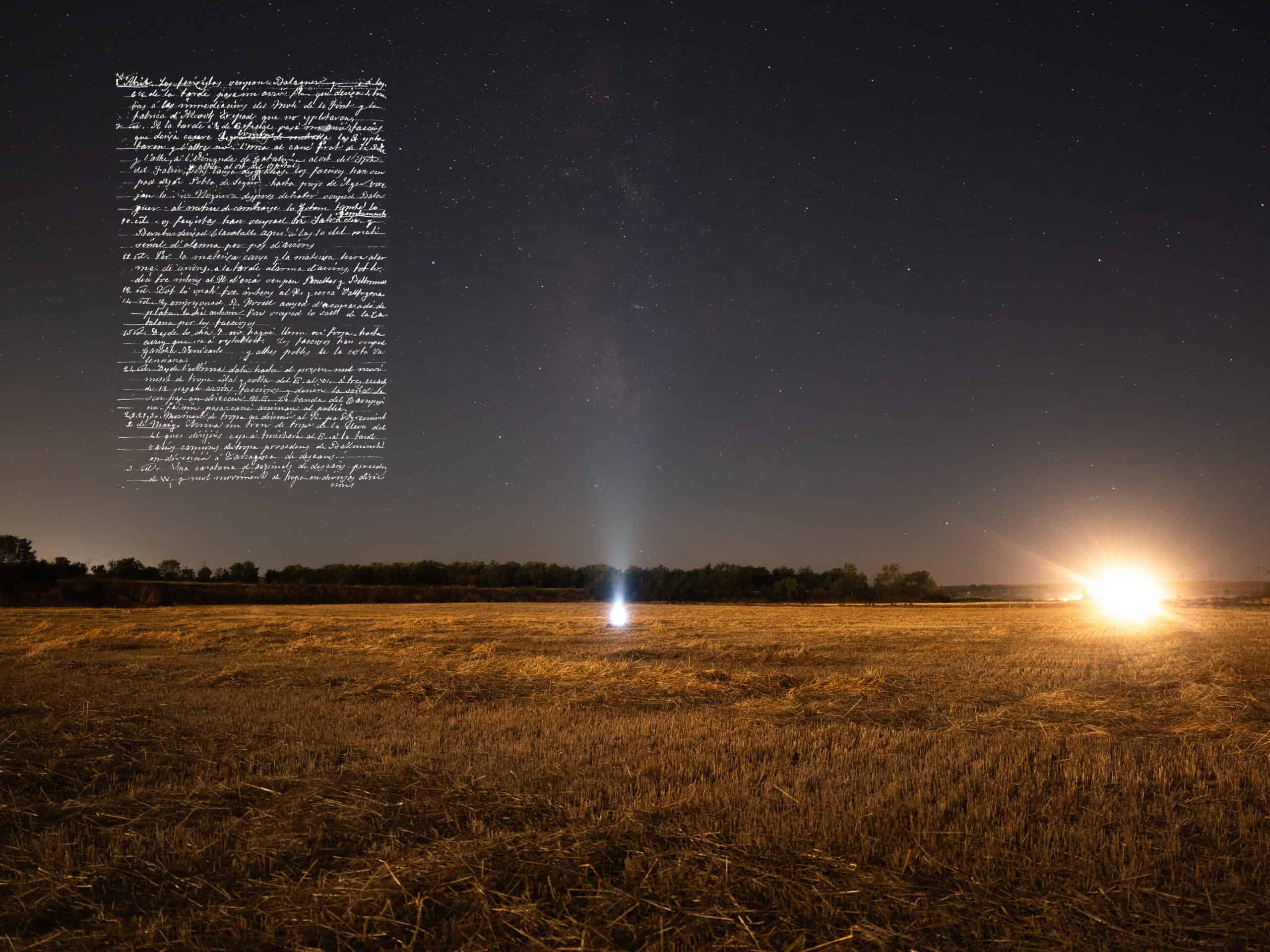
- A diary entry from Tàrrega 7.IV.1938
- Trench · rest · church Vilanova · 2024
- A night inside the cabin Aragón · 2024
- El Cristo de Monteagudo Murcia · 2026
- The medal Multiple sites
Three sites in three days. The first thing you understand about a re-enactment is that it is a battle without a winner and with all the dust of one. The town of Flix wakes up to smoke bombs in its streets, the kind that took the breath out of soldiers in 1938 and now choke a Sunday morning audience equally. In Vilanova de la Barca, halfway between Zaragoza and Barcelona, the mortar is meant for the other side — and arrives there.
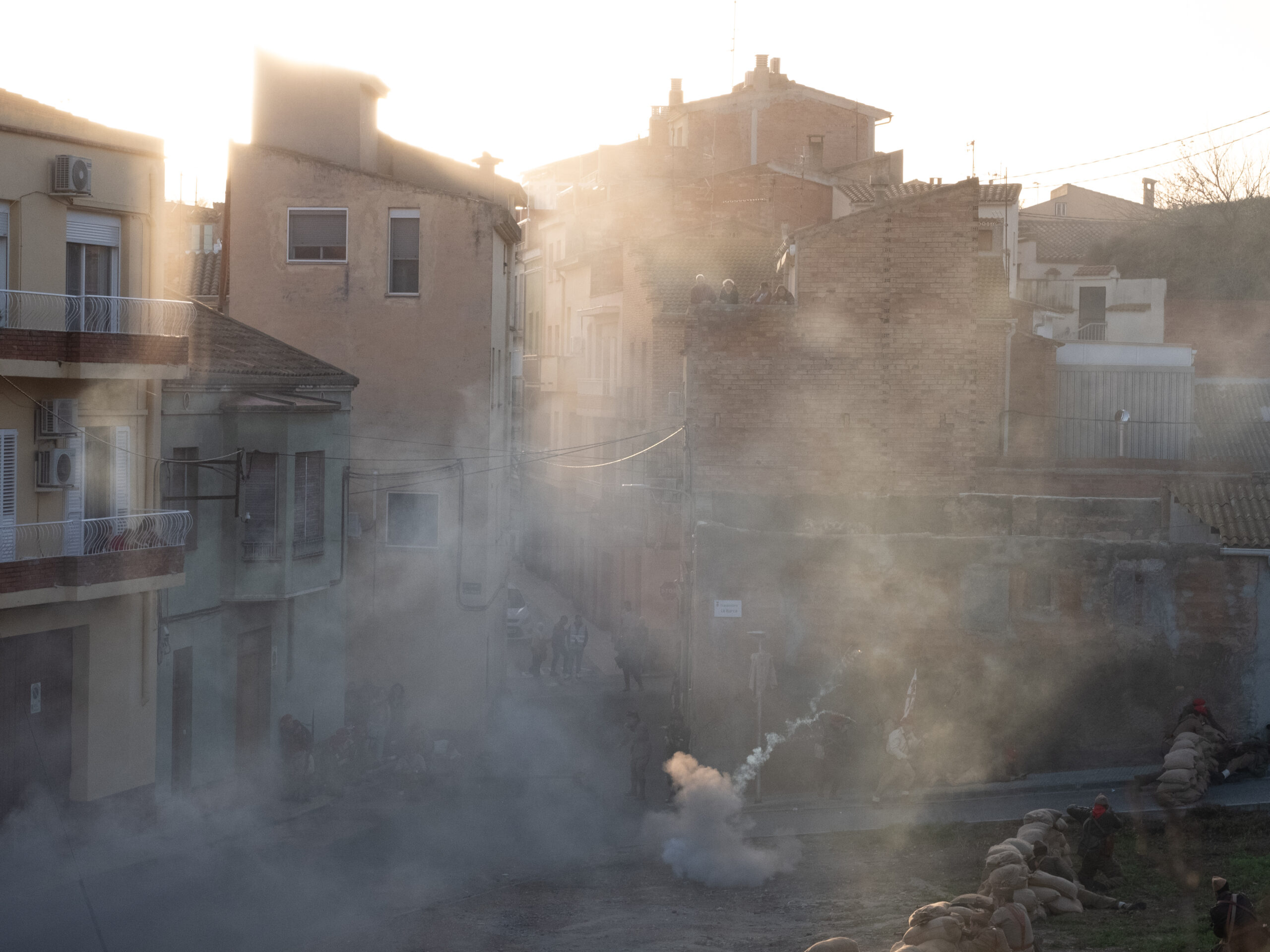
The audience does not know this. The audience sees only the assault. They do not see the bakery, or the car, or the small radio someone keeps on the dashboard to listen for the signal.
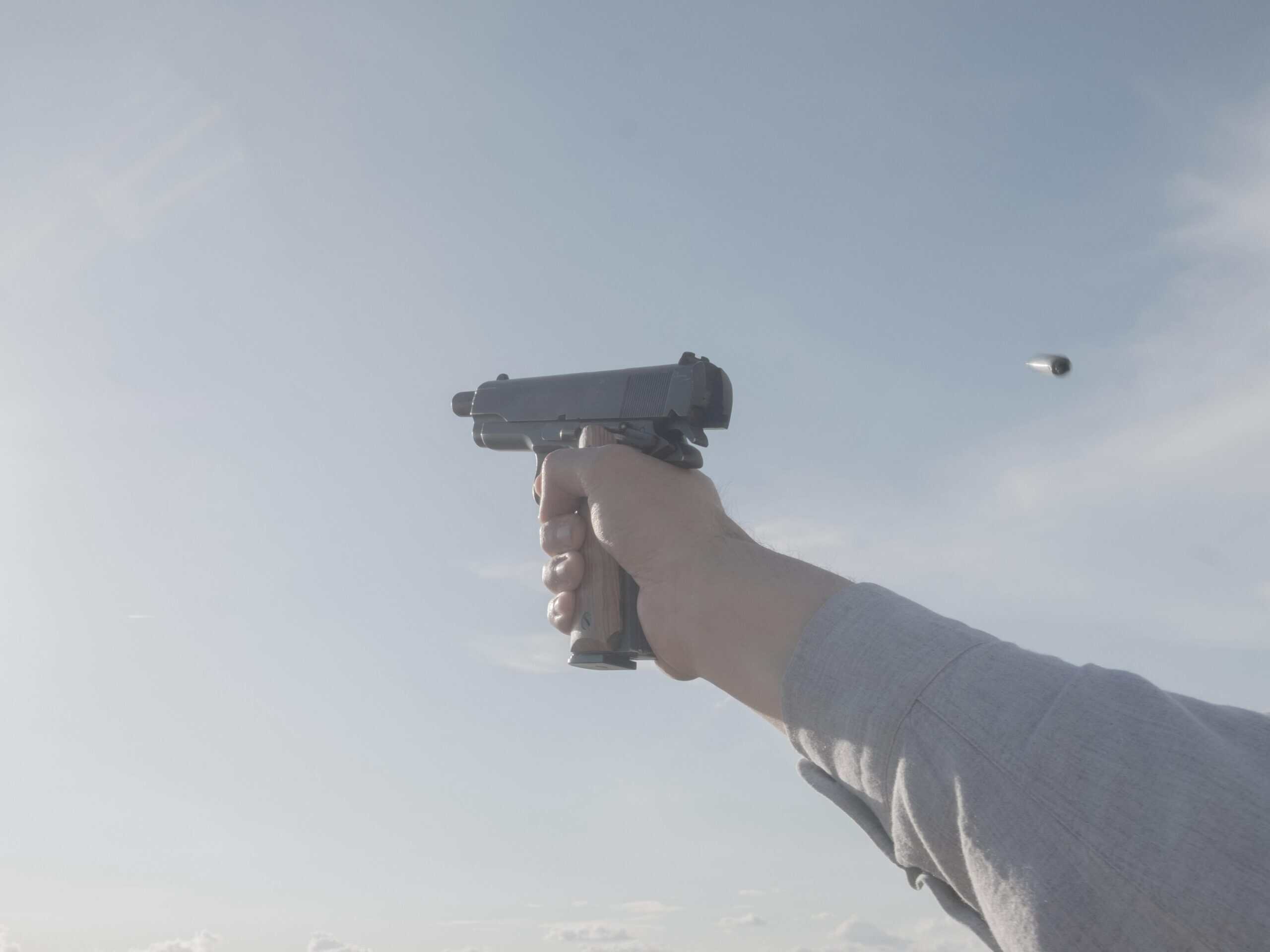
A blank round is fired into the sky — not to hit, but to be heard. In the early months of the Spanish Civil War, dissuasive fire was often the only option. Many fighters had no real training, barely any bullets, and rifles that failed after a few shots.
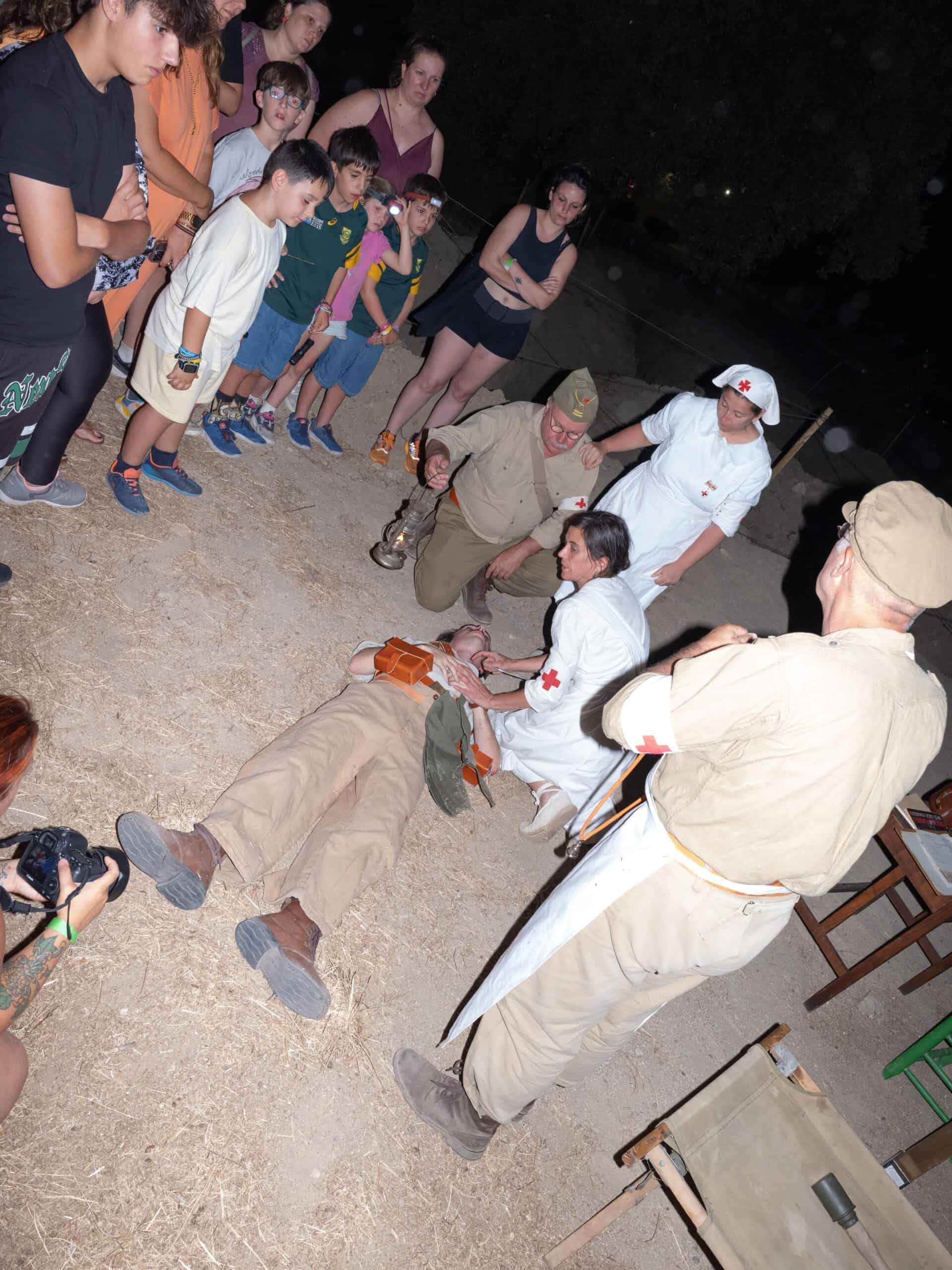
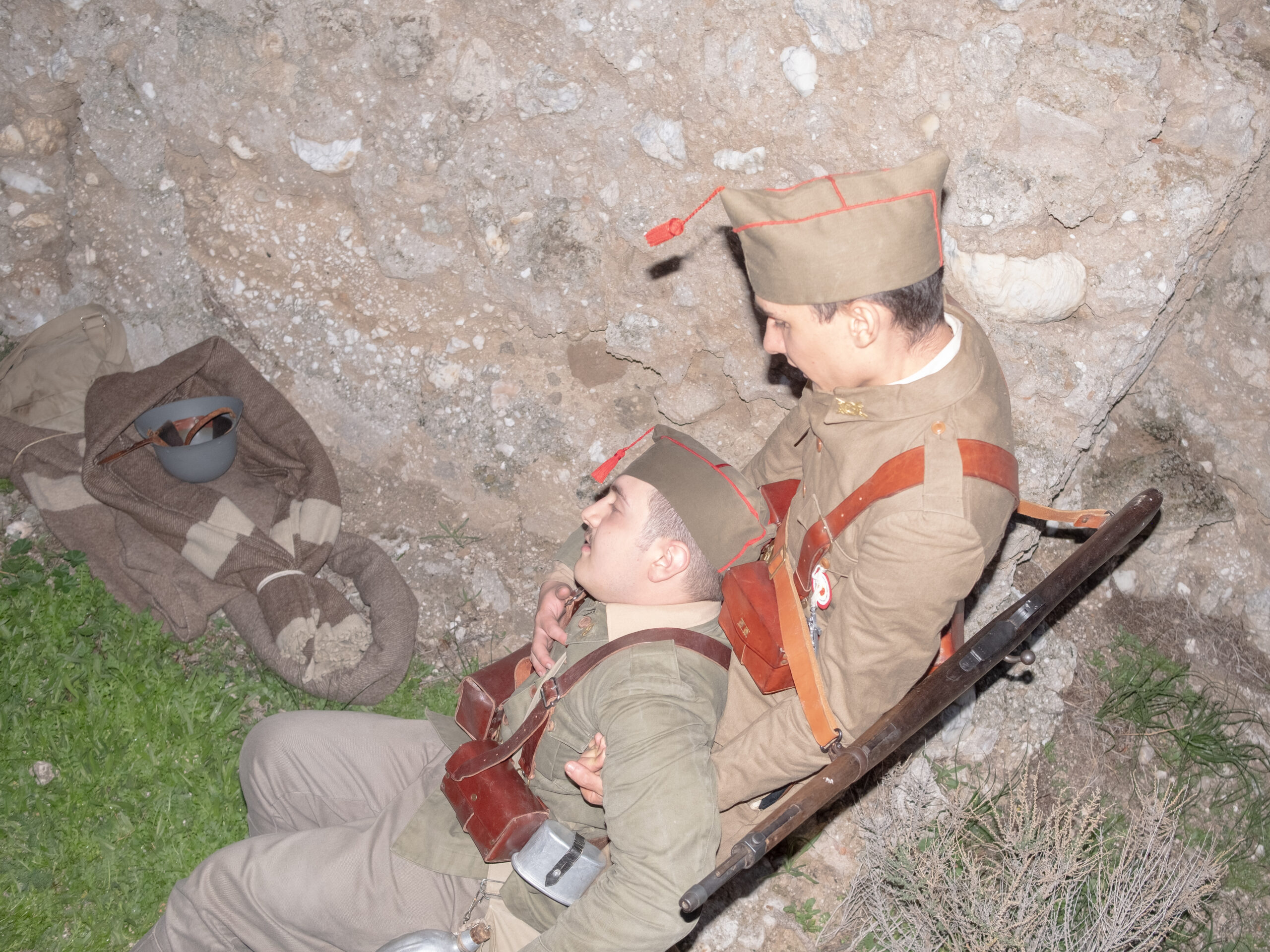
A wounded soldier during the reenactment of the Battle of Brunete. He crawls reappears minutes later, limping slightly, pulled by two others along the edge of the road. No more audience, just the dark and the dust. They carry him through the quiet until they reach the light again — the improvised infirmary under the open sky.
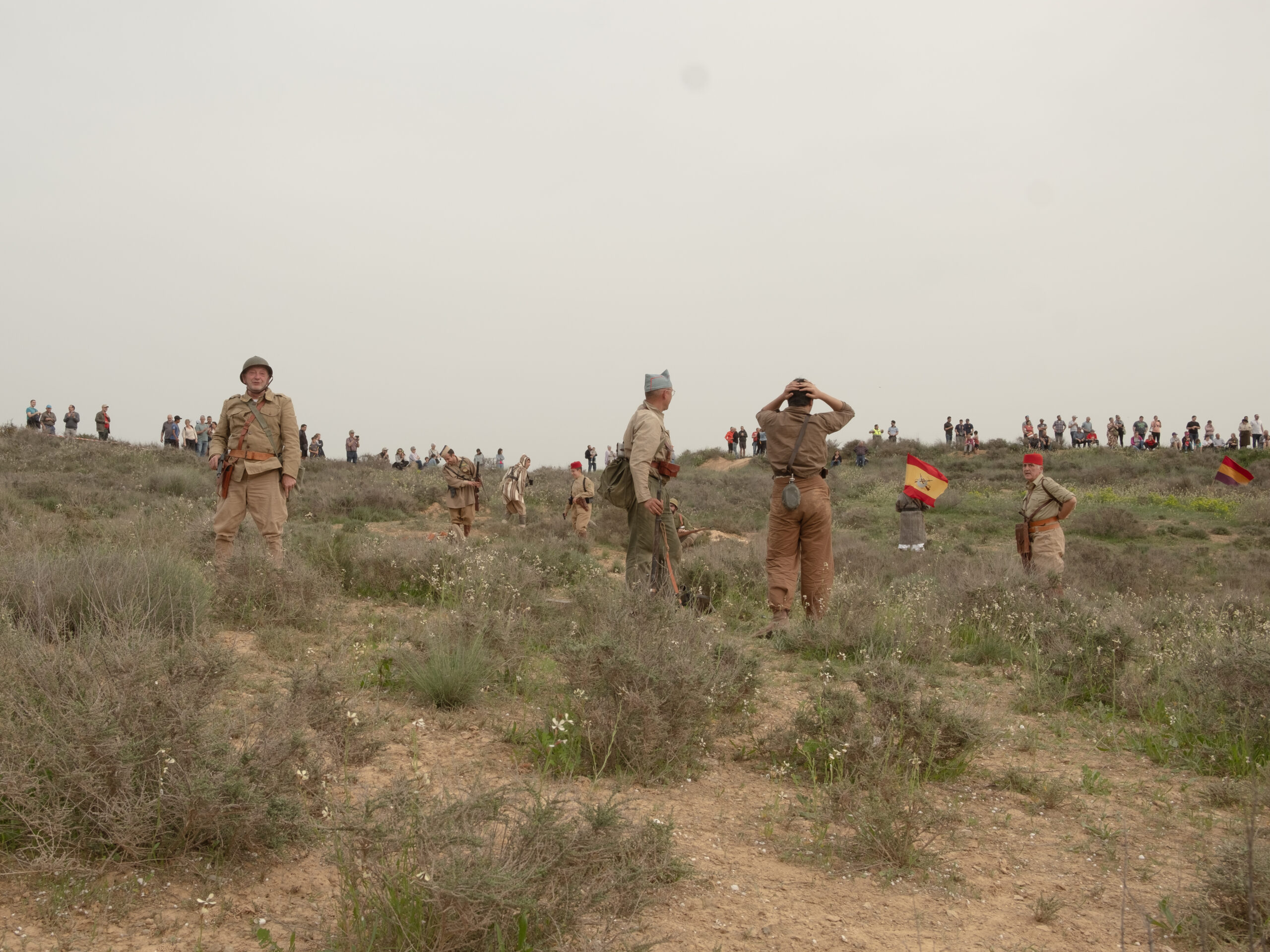
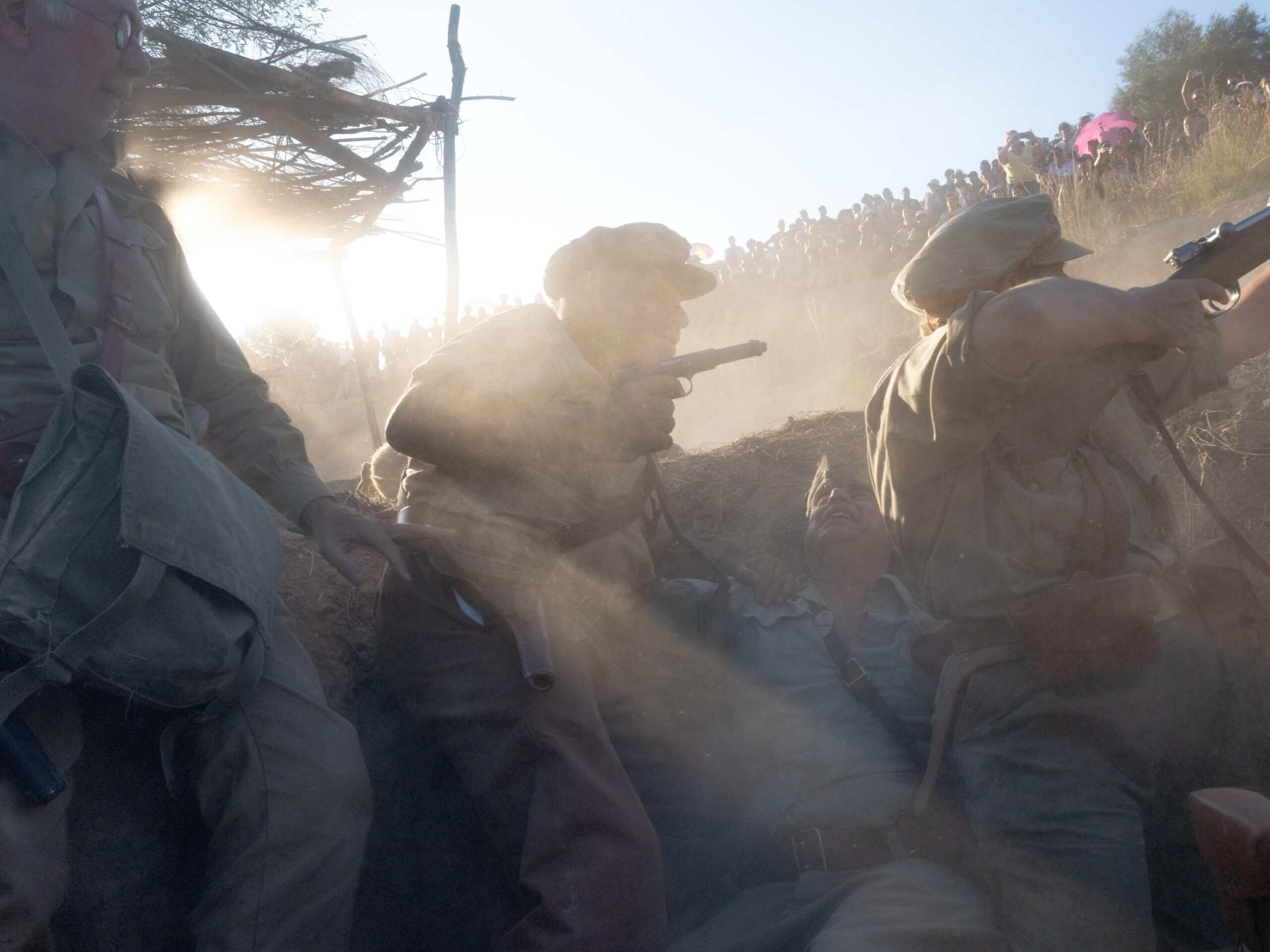
"¡Viva Cristo Rey!" The cry snaps across the trench just as the Nationalist wave breaks over the Republican line. On this slope near Fayón, Spain's largest Civil War reenactment gathers more than a hundred volunteers — locals joined by Americans, French, Germans, and others — to replay the decisive 1938 Battle of the Ebro. Spectators ring the rim of the hill, cheering while the scripted assault takes place below.
For a brief afternoon, they share the same swirling dust.
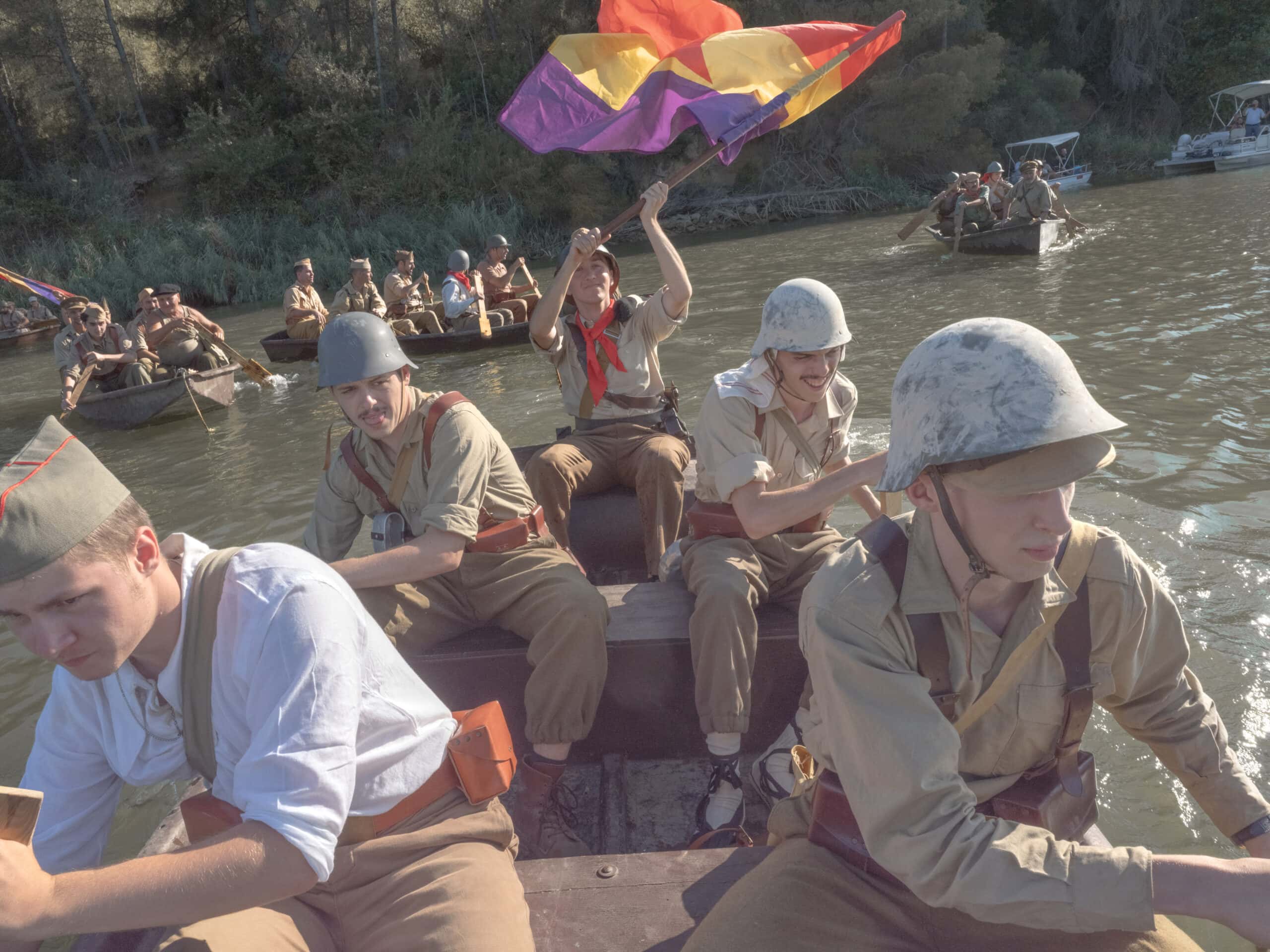
The Battle of the Ebro began on July 25, 1938 and lasted 115 days. It killed somewhere between thirty and fifty thousand people. It was the longest, largest, and most exhausting battle of the war. It was also the moment the Republic stopped winning. When you stand on this slope today, that history is invisible: the wheat is the wheat, the dust is the dust, the cars on the road are commuter cars headed for Tarragona. Only the reenactment briefly reinstalls the noise.
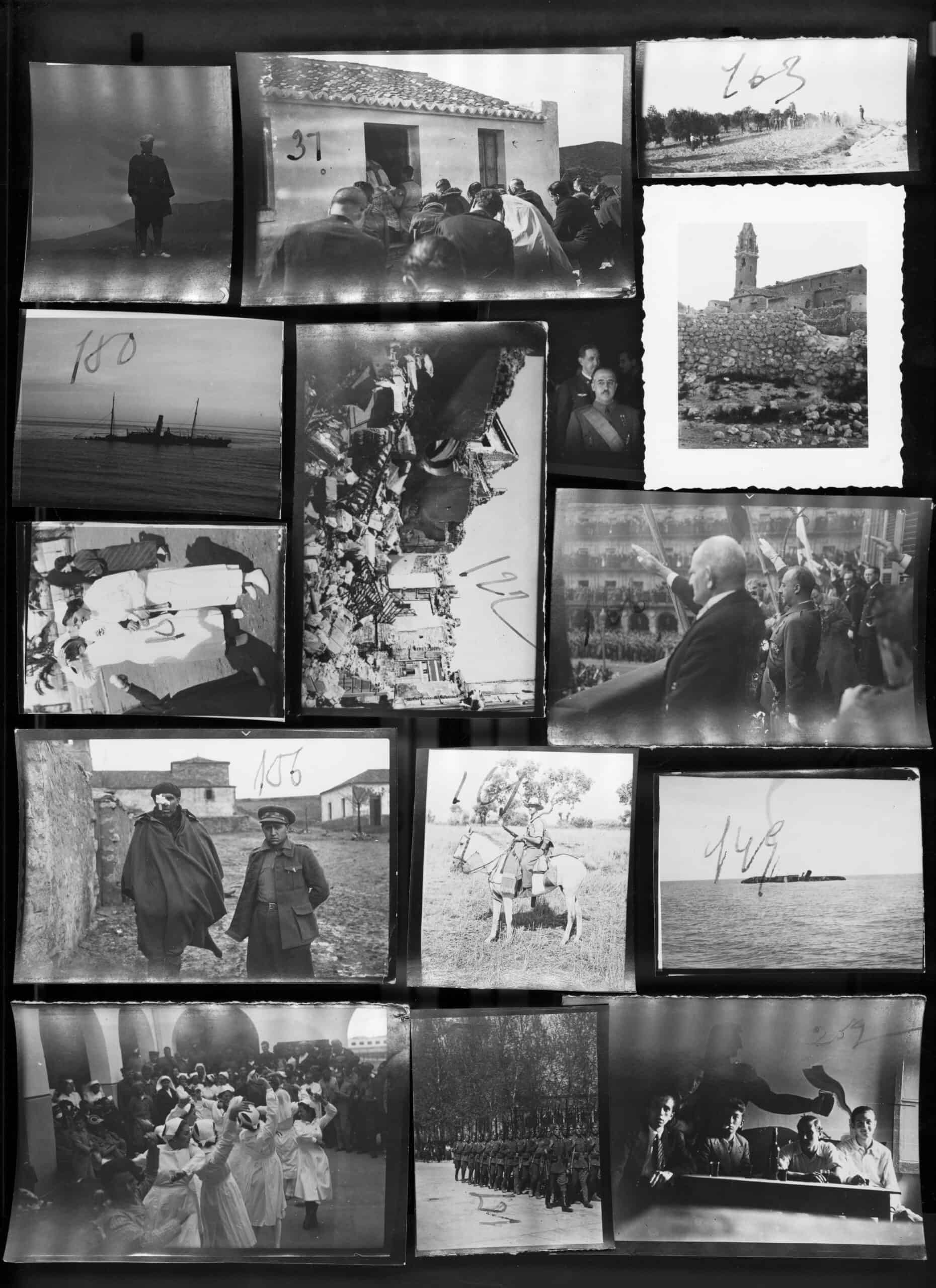
Fifteen shards on a strip of film.
A wreck listing off the coast. A church tower pulverised to rubble. Bodies on whitewashed stone. A triumphant salute in a packed plaza. An overturned tank. Two soldiers wrapped in a blanket of mud. Hospital nurses dancing to drown the noise. A platoon drilling across frozen ground.
Rodén has been uninhabited since its two hundred inhabitants fled the war. The exact moment it became a ghost town is uncertain, but it likely occurred between 1936 and 1937. The new Rodén sits across the road, a kilometre down. The old one stays where it was.
New Rodén · ≈ 90 inhab. today
Two villages, one name, one km apart.
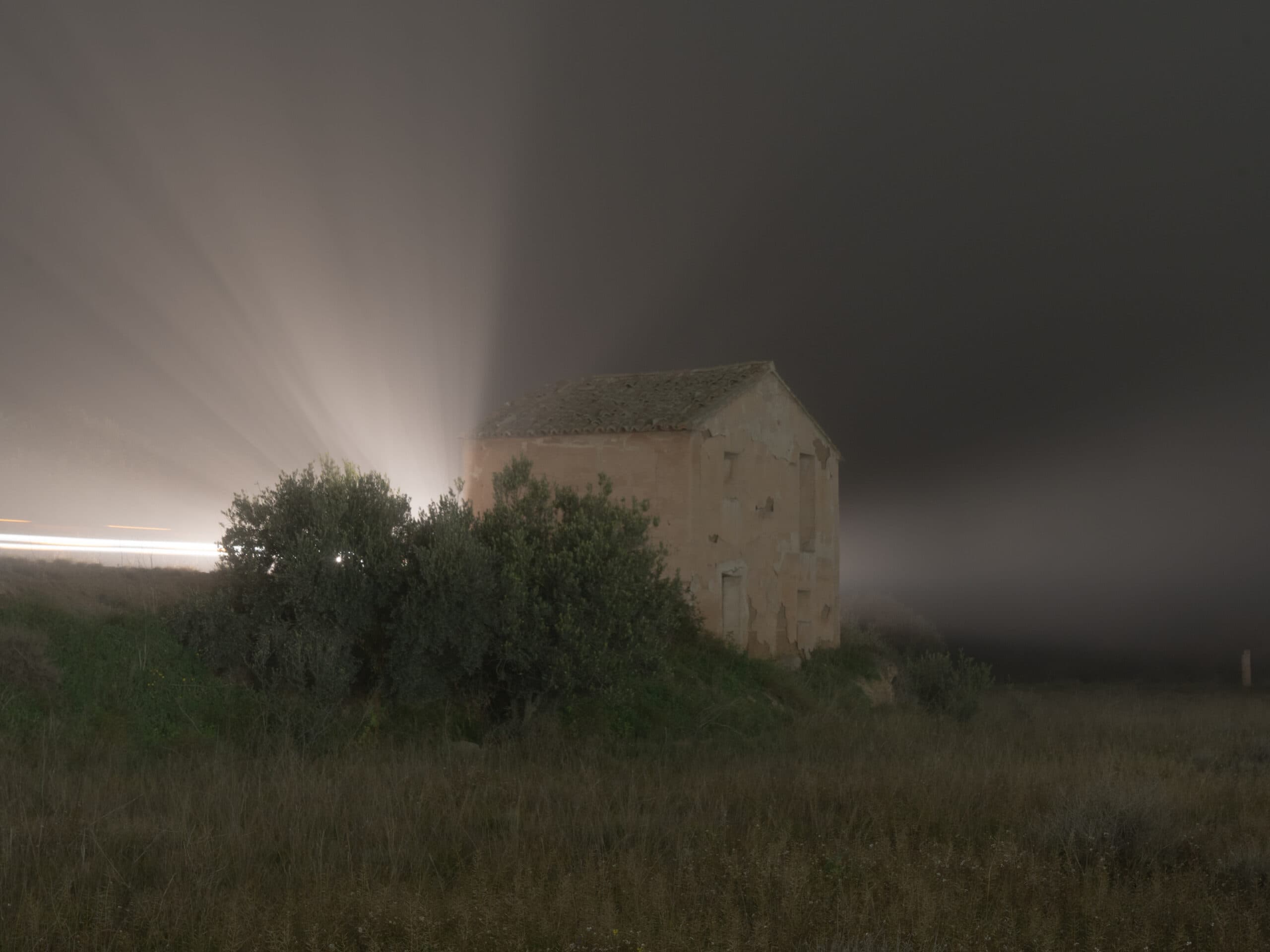
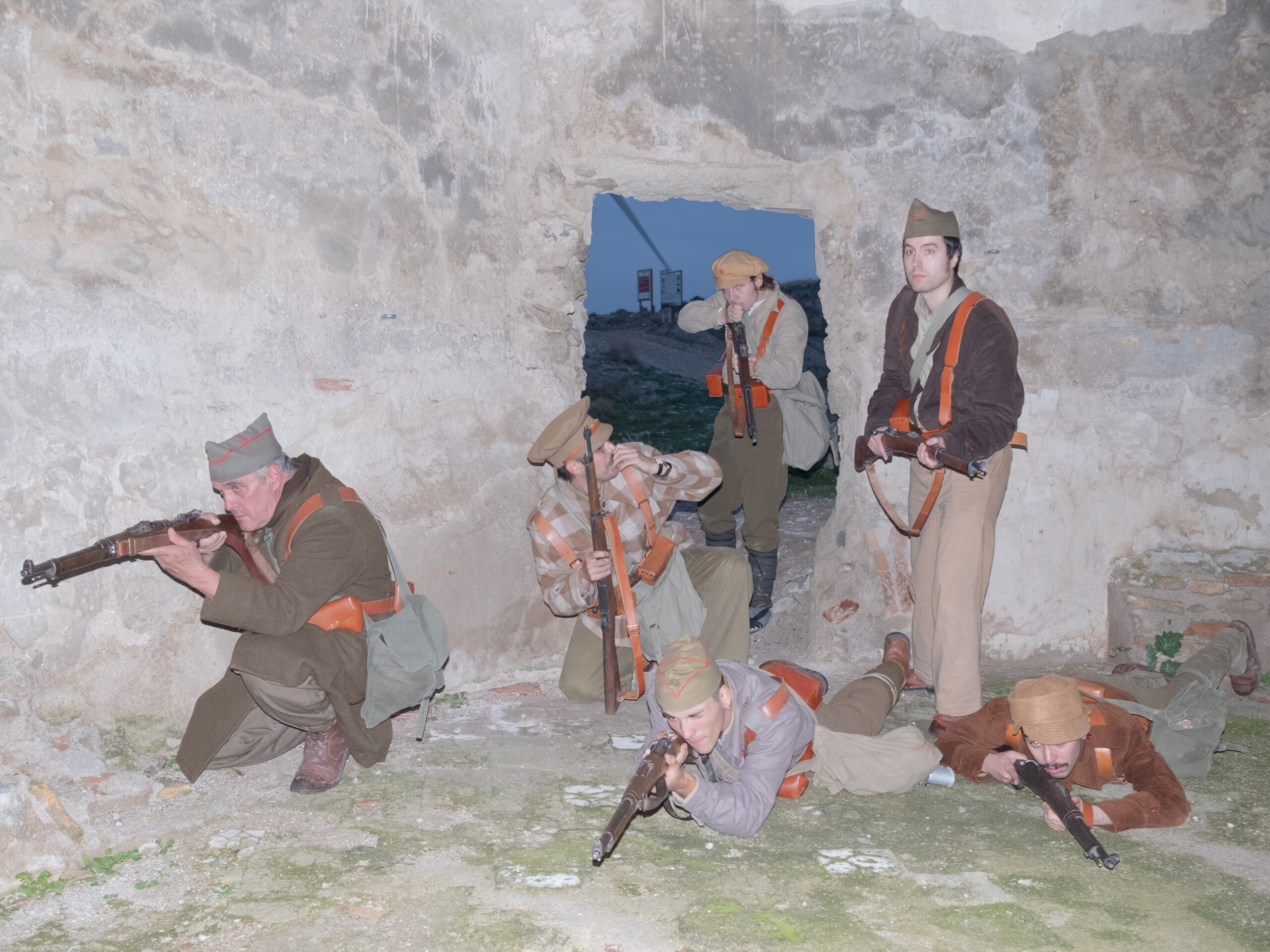
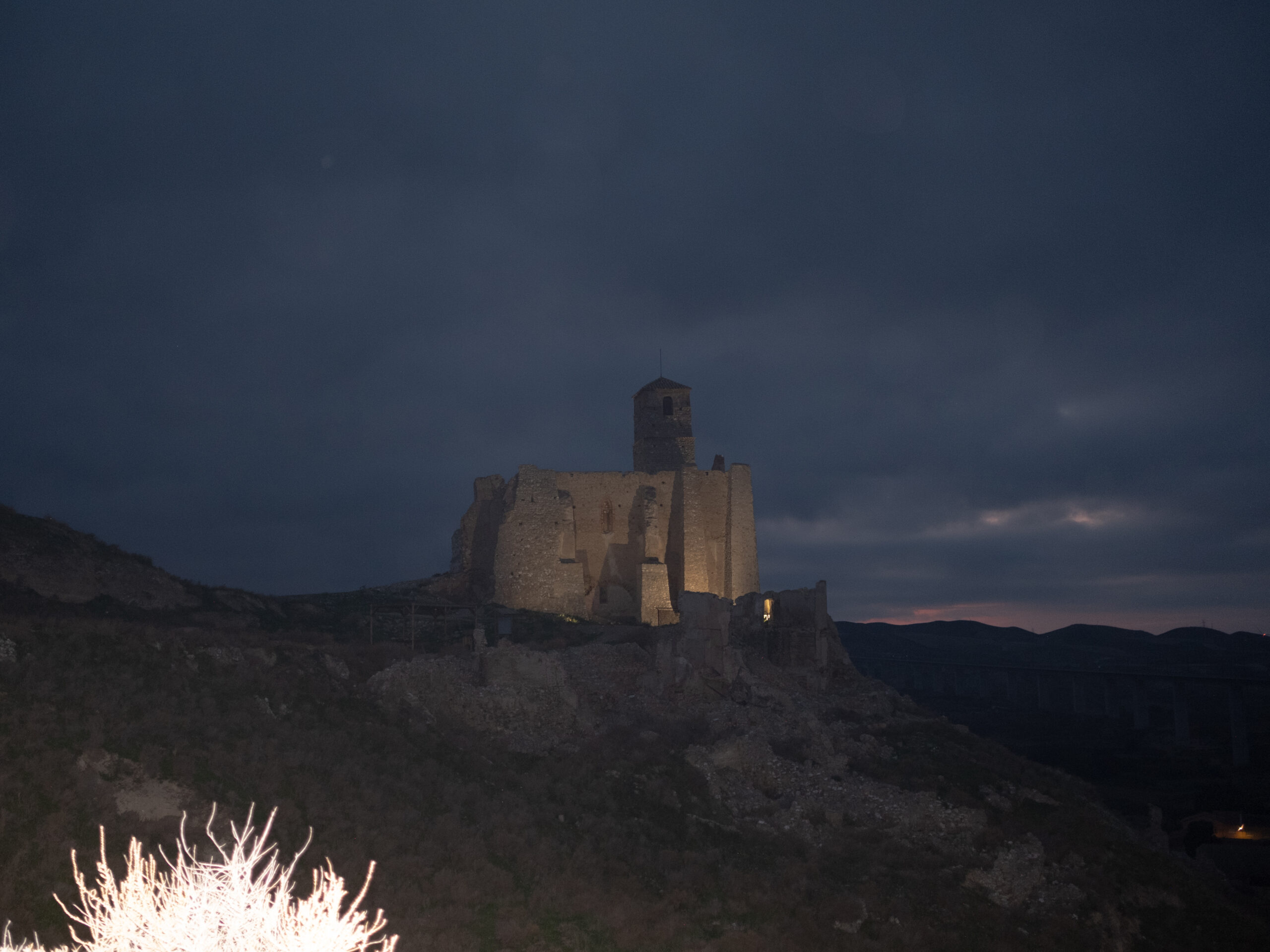
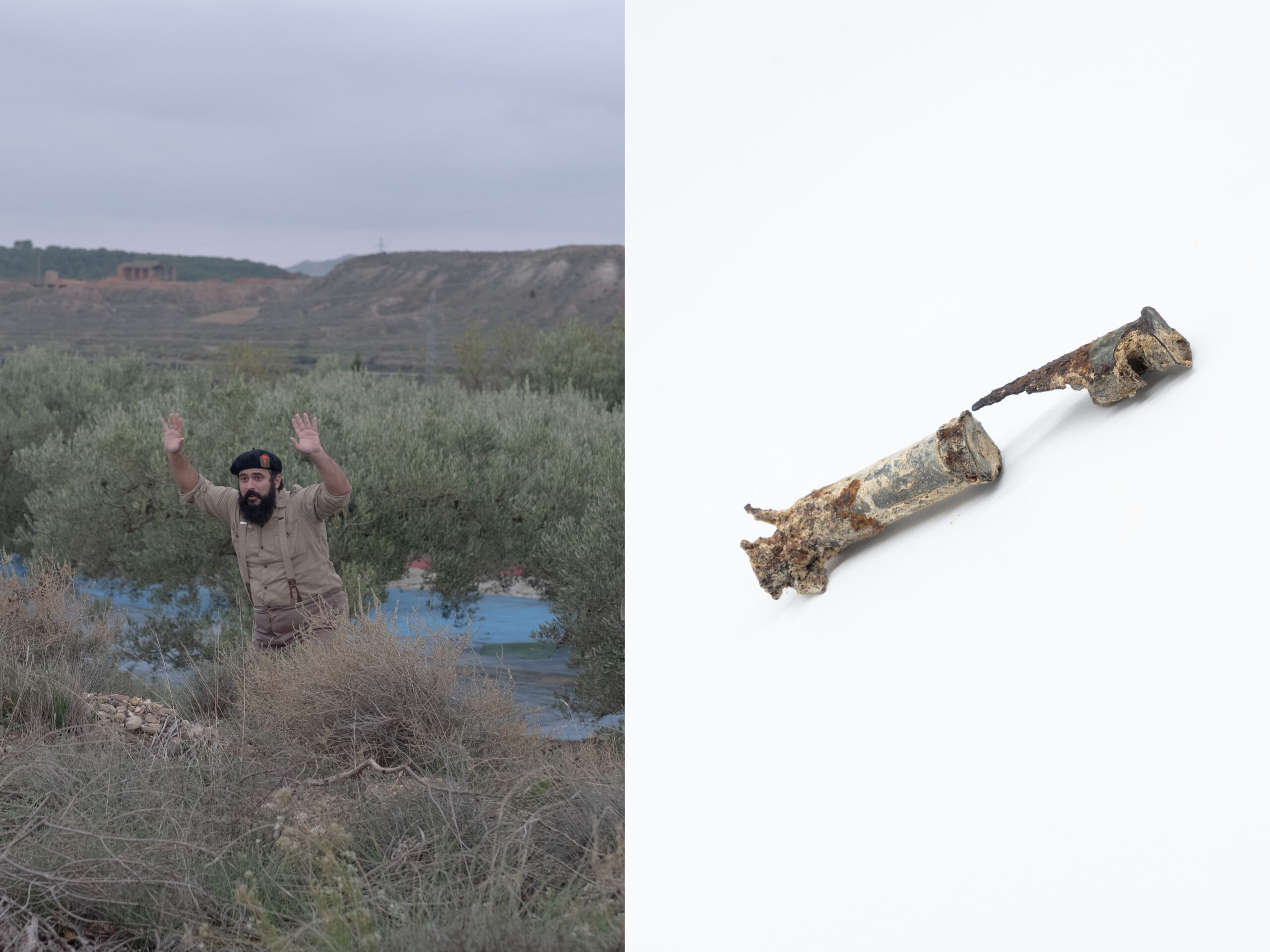
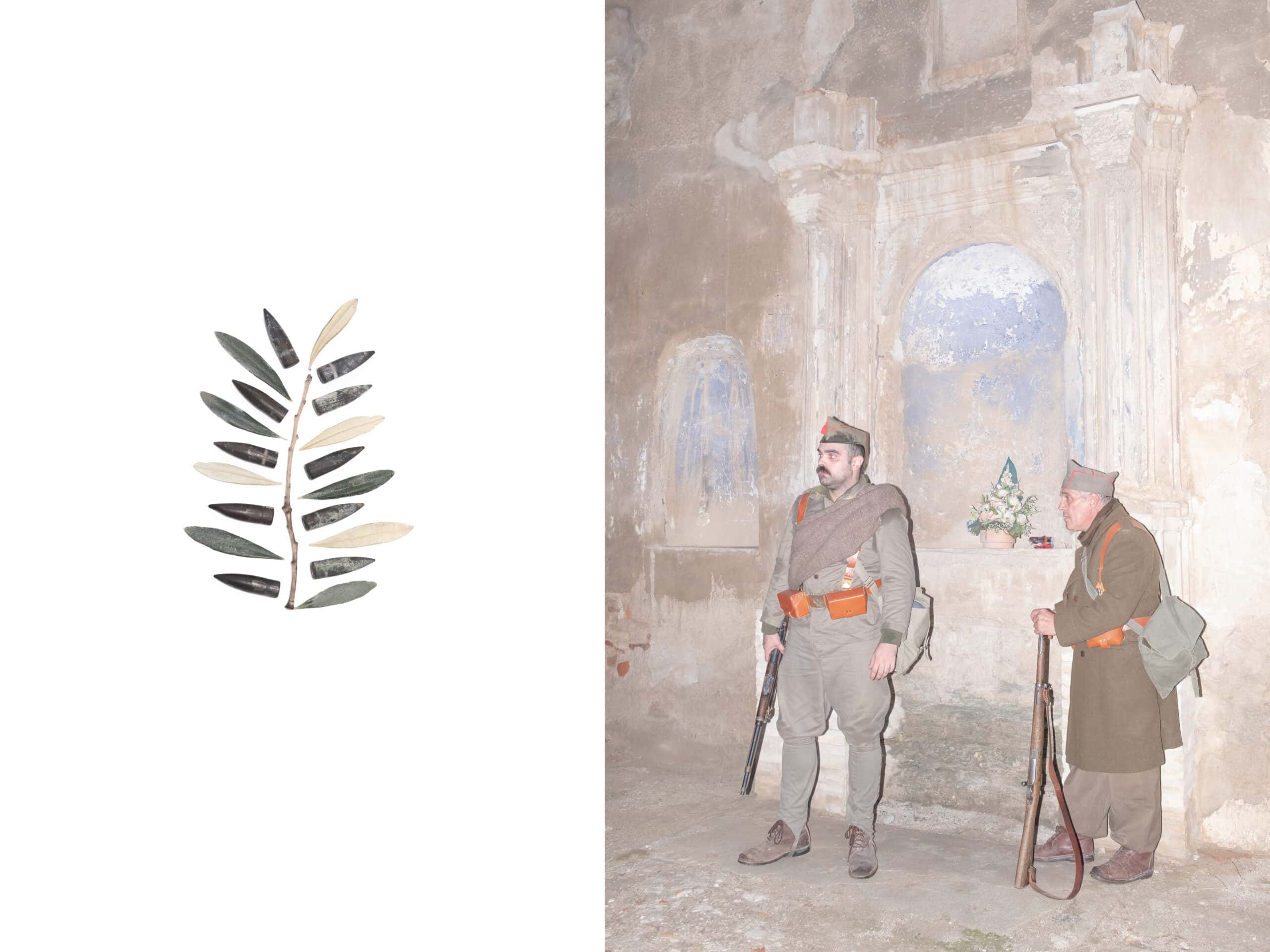
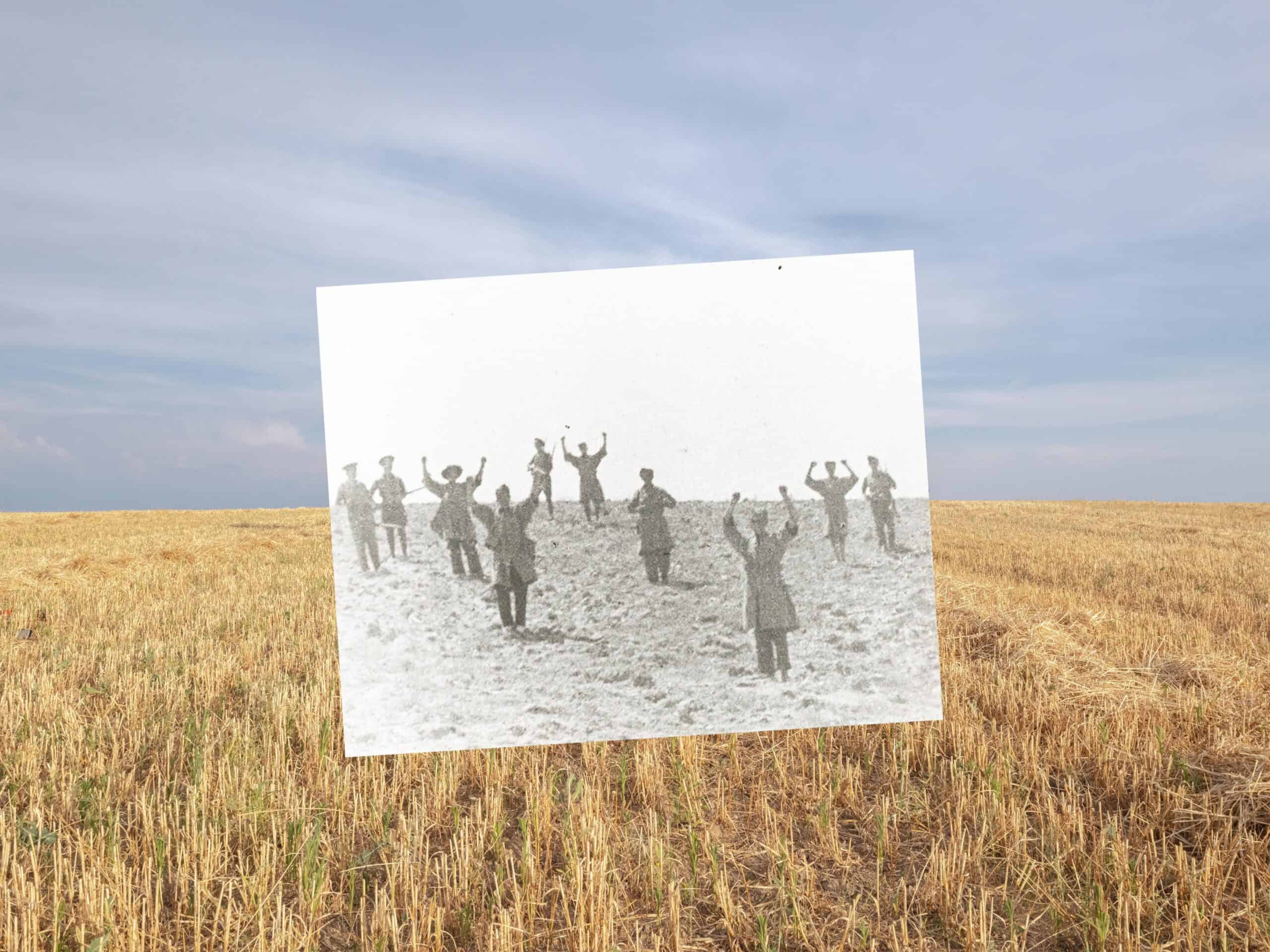
Sometimes, you have to surrender. Here, a Republican re-enactor raises his hands during a Nationalist ambush in an olive grove. The soldier was caught in a moment of vulnerability, set in a landscape still connected to wartime.
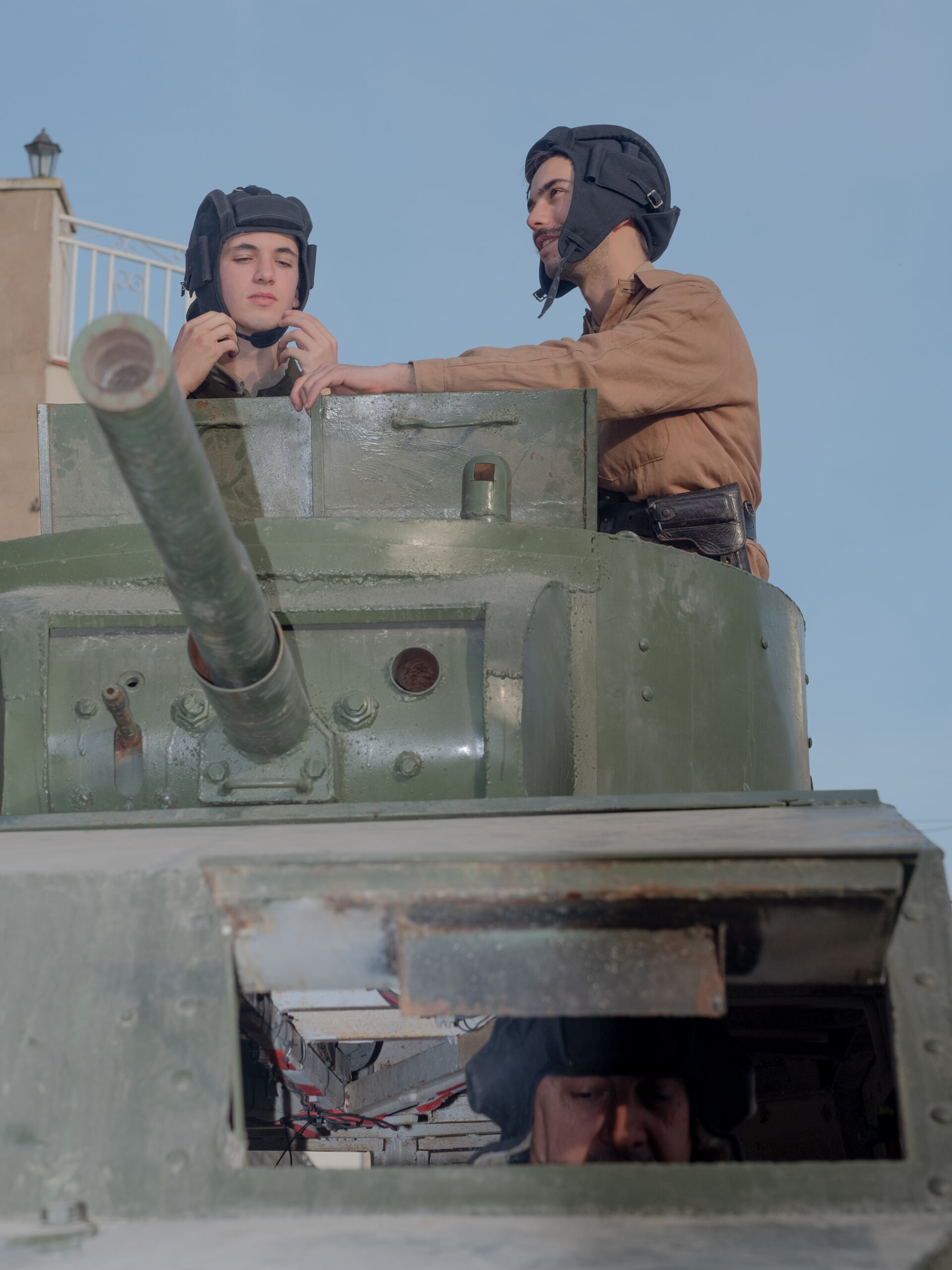
Republican soldiers ready themselves inside a tank loaded with smoke bombs designed to simulate its destruction. The battle, their last central stand, symbolised determination against overwhelming odds. Strategy and courage were no match for dwindling supplies and growing isolation.
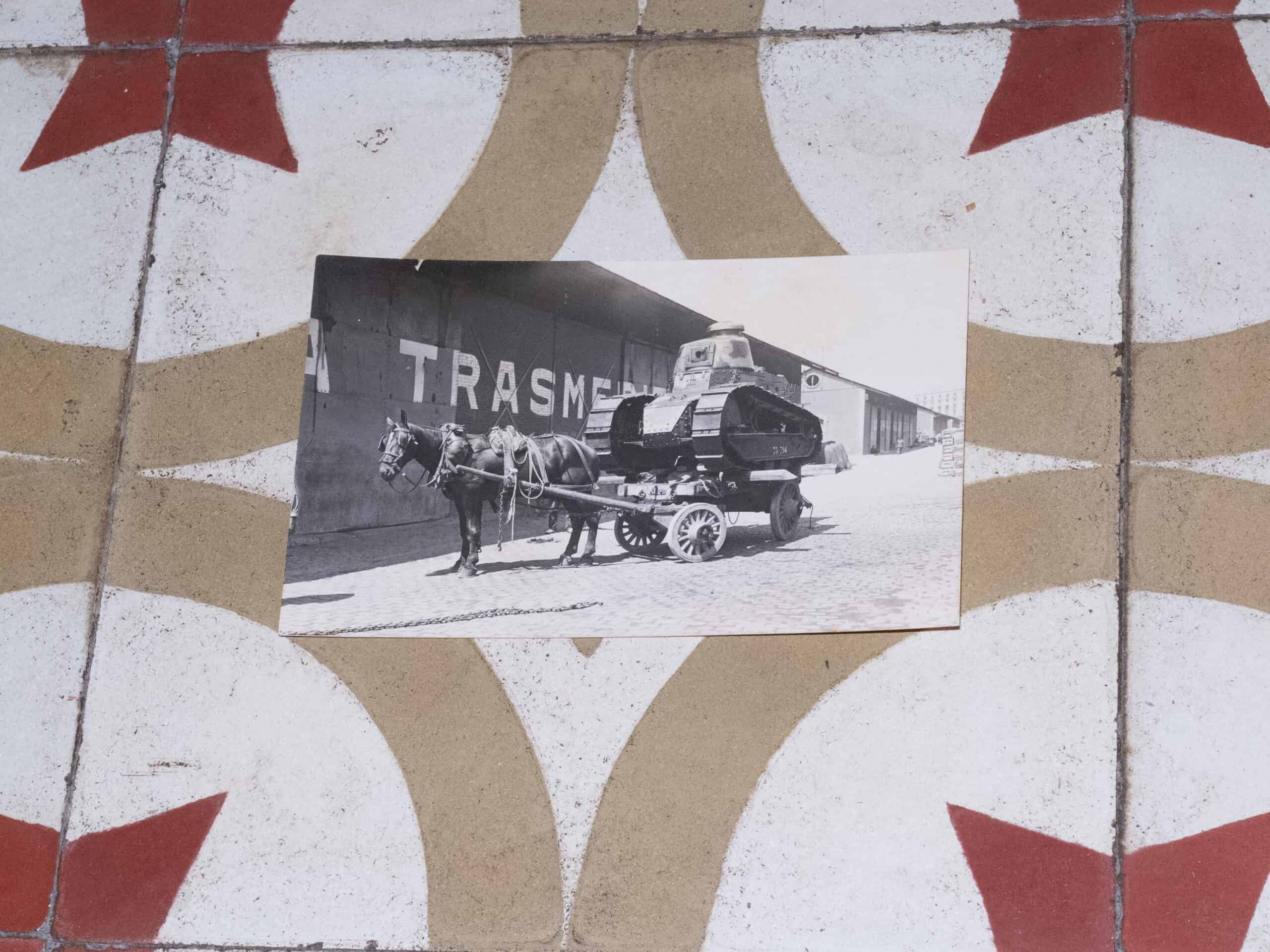
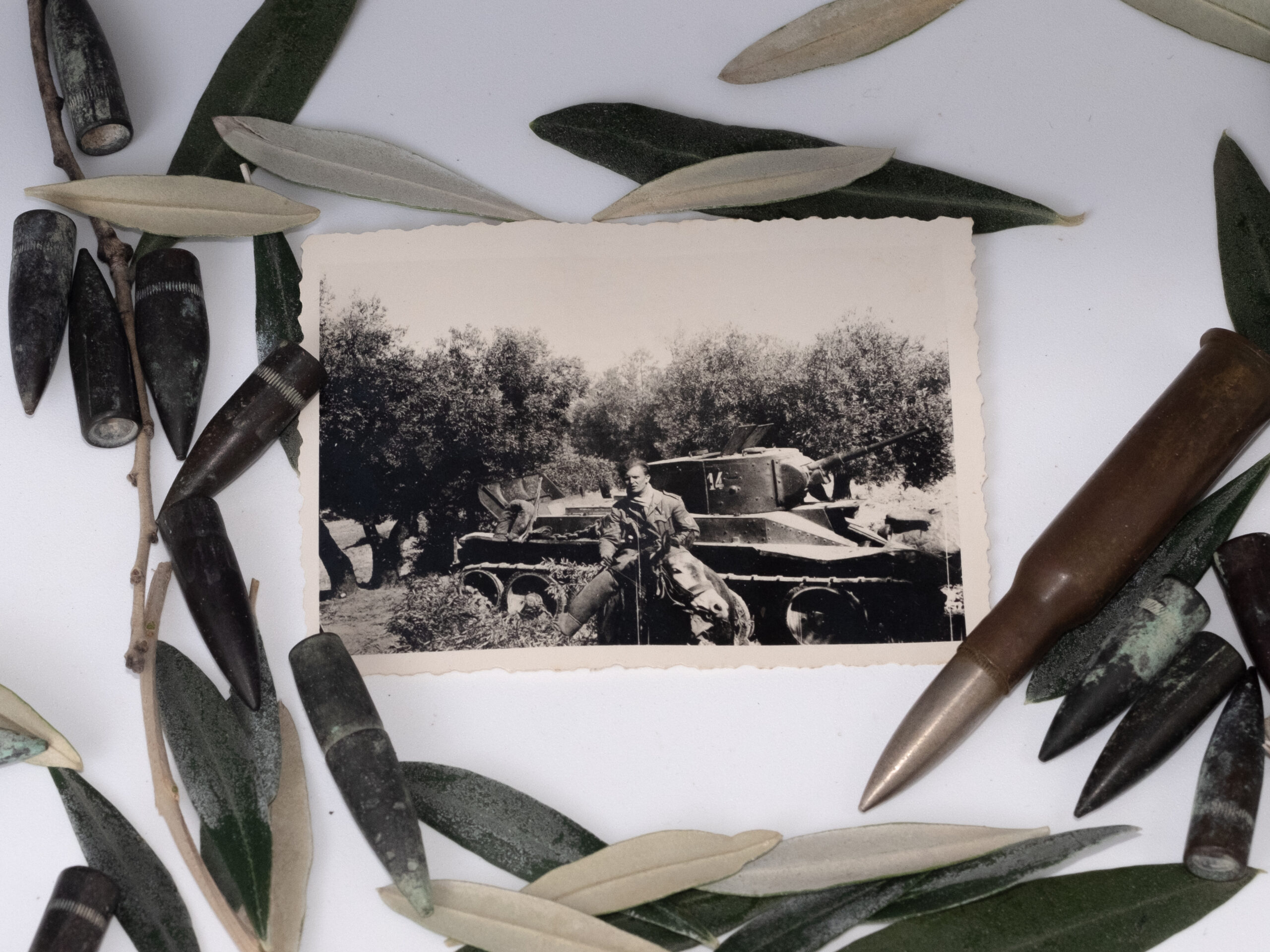
Three photographs from the period circulate among today's re-enactors. They were never published in any book. They survived in a shoebox, a leather folder, the glass cabinet of a town museum. None has a confirmed author. Each one bears only a date.
They are the kind of object the project hopes to lift from private silence back into the cartographic, public archive.
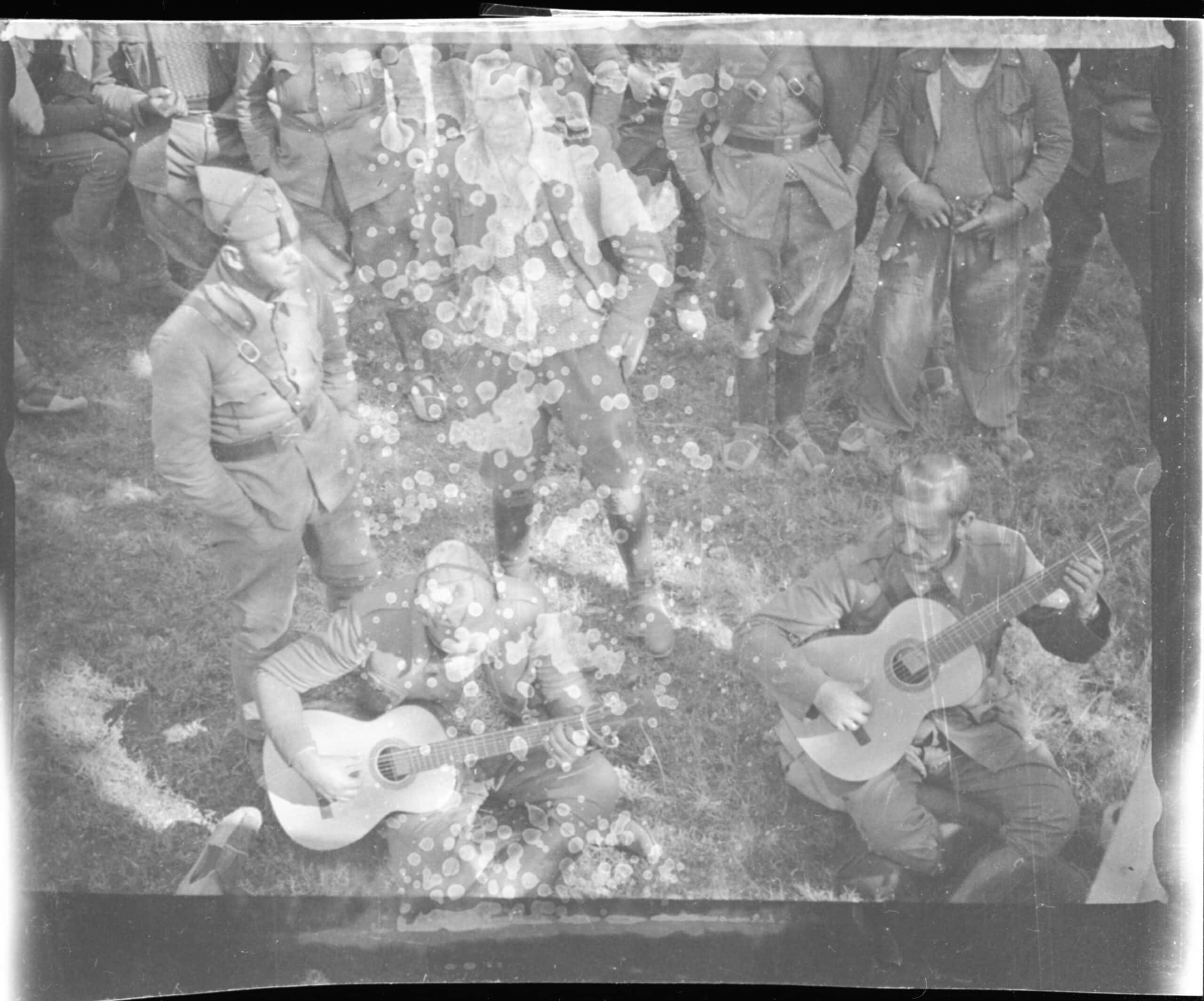
The other photograph of "the falling soldier".
The contact sheet that should have existed and does not. Six frames staged on the same coordinates Capa shot from on 5 September 1936.
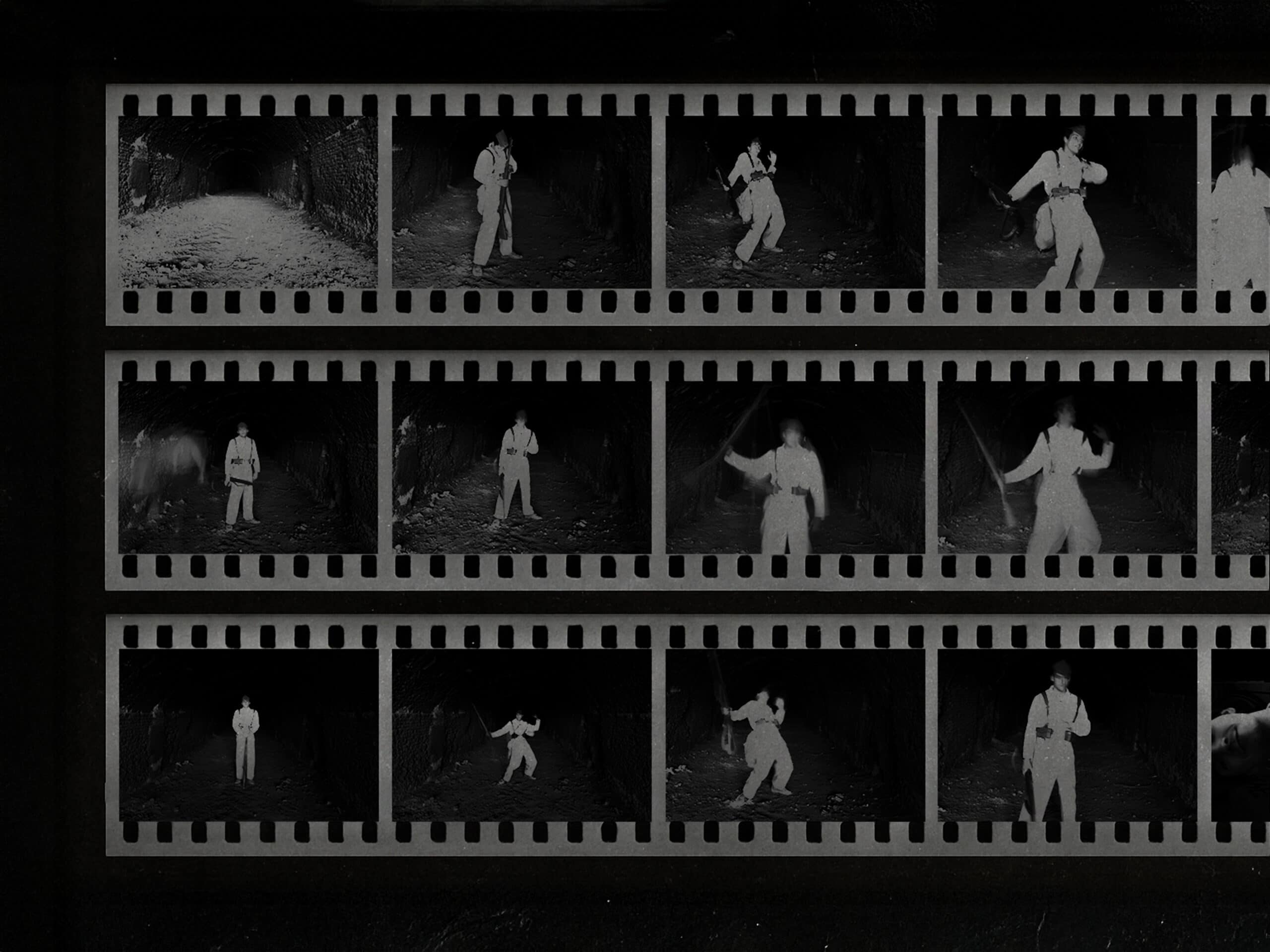
In 1936, on the Córdoba front near Cerro Muriano, Robert Capa made the photograph later known as The Death of a Militiaman. No contact sheet or negatives from that day survive: none at the International Center of Photography in New York, and none surfaced in the so-called Mexican Suitcase — three boxes of negatives by Capa, Gerda Taro, and Chim found in 2007.
What preceded the icon remains unknown. The frames before and after the falling soldier — the moments that would tell us whether the man was hit, posed, ducking, or climbing back up — are not in any archive. They never have been.
The sheet above is fiction, declared as such. The image performs what the archive refused to produce. This is the only operation that makes the archive's silence visible.
"Robert Capa" was, in any case, two people. Endre Ernő Friedmann and Gerda Taro. Both published under the same name. Both staged at least some of what they shot. Taro arrived after the battles she photographed; her prisoners raise their arms in a frame she set up. The reenactors at Brunete in 2025 restage that pose on the same wheat. The project is not about catching the lie. It is about understanding that the lie was already there, at the origin, and that we have built a century of remembrance on top of it.
Sean Edwards is an American citizen living in Spain. In the project, he plays a correspondent photographer for the International Brigade. He uses a Wirgin from 1937, real, with real film, real techniques. Half the project's "reimagined" frames pass through his camera. The other half through mine.
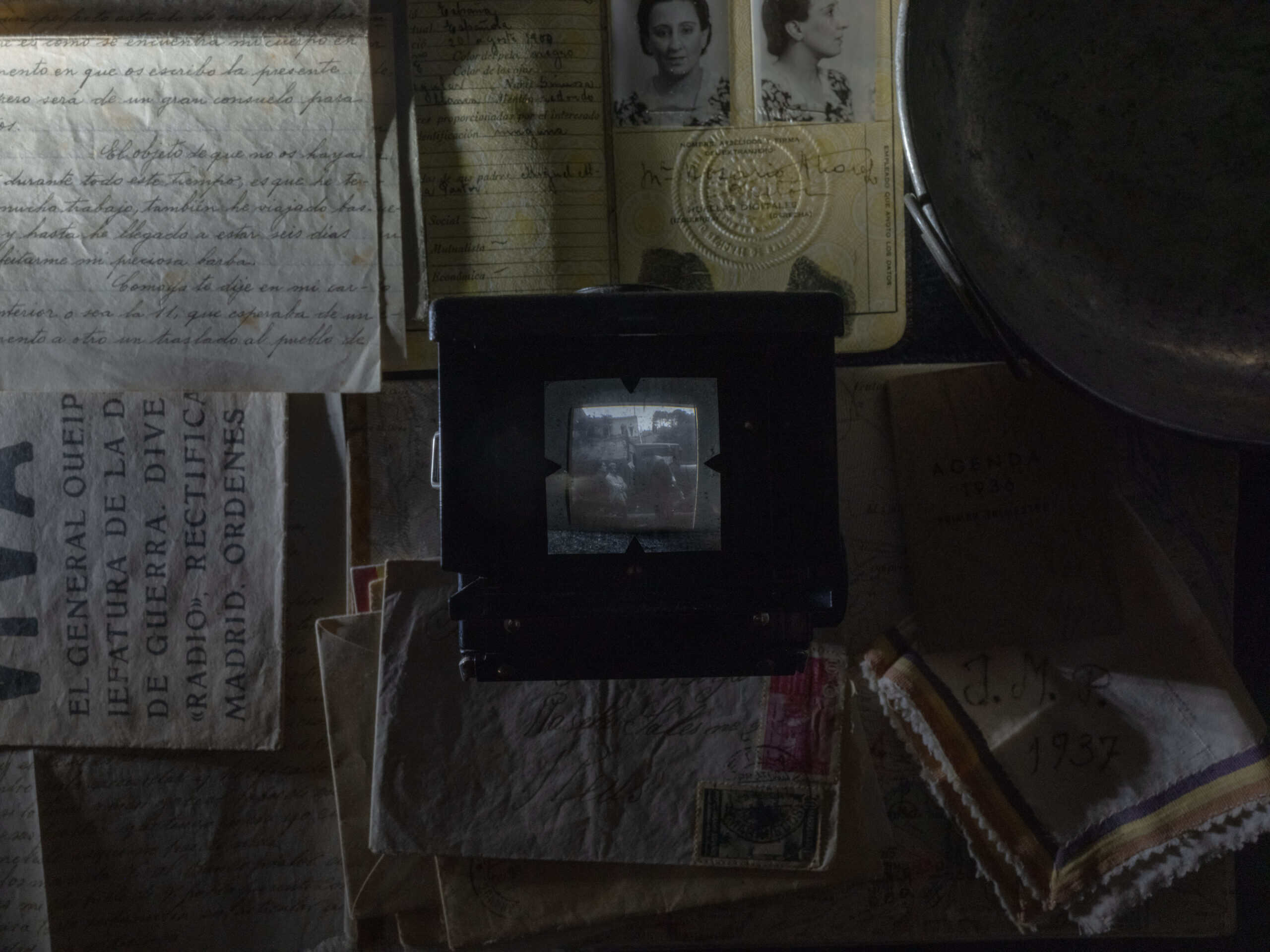
In 2025, on the very ground where Gerda Taro staged a scene of resistance in July 1937, today's re-enactors prepare to recreate that act. Taro arrived after the battle, capturing a reality reimagined — prisoners with raised arms, staged to lift Republican morale — an act of propaganda within documentary form.
Taro was twenty-six. She would die on this front three weeks later, hit by a Republican tank during the retreat. Her name was Gerta Pohorylle, born in Stuttgart, and "Gerda Taro" was the alias she invented with Friedmann when they began working together. The pose she staged at Brunete became iconic. The retraction — that the prisoners were Republican soldiers playing prisoners — came decades later, after she could no longer defend or qualify what she had done.
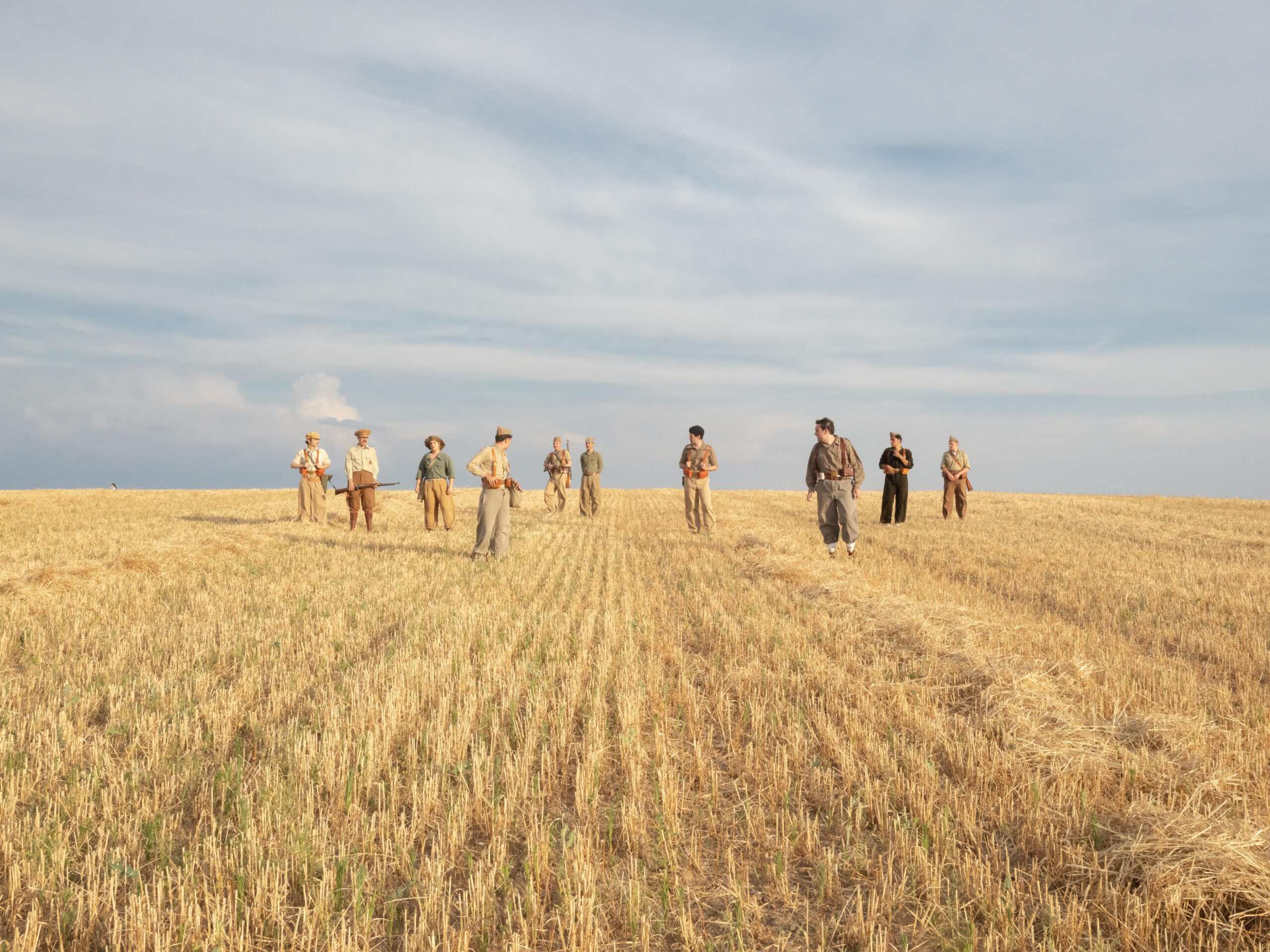
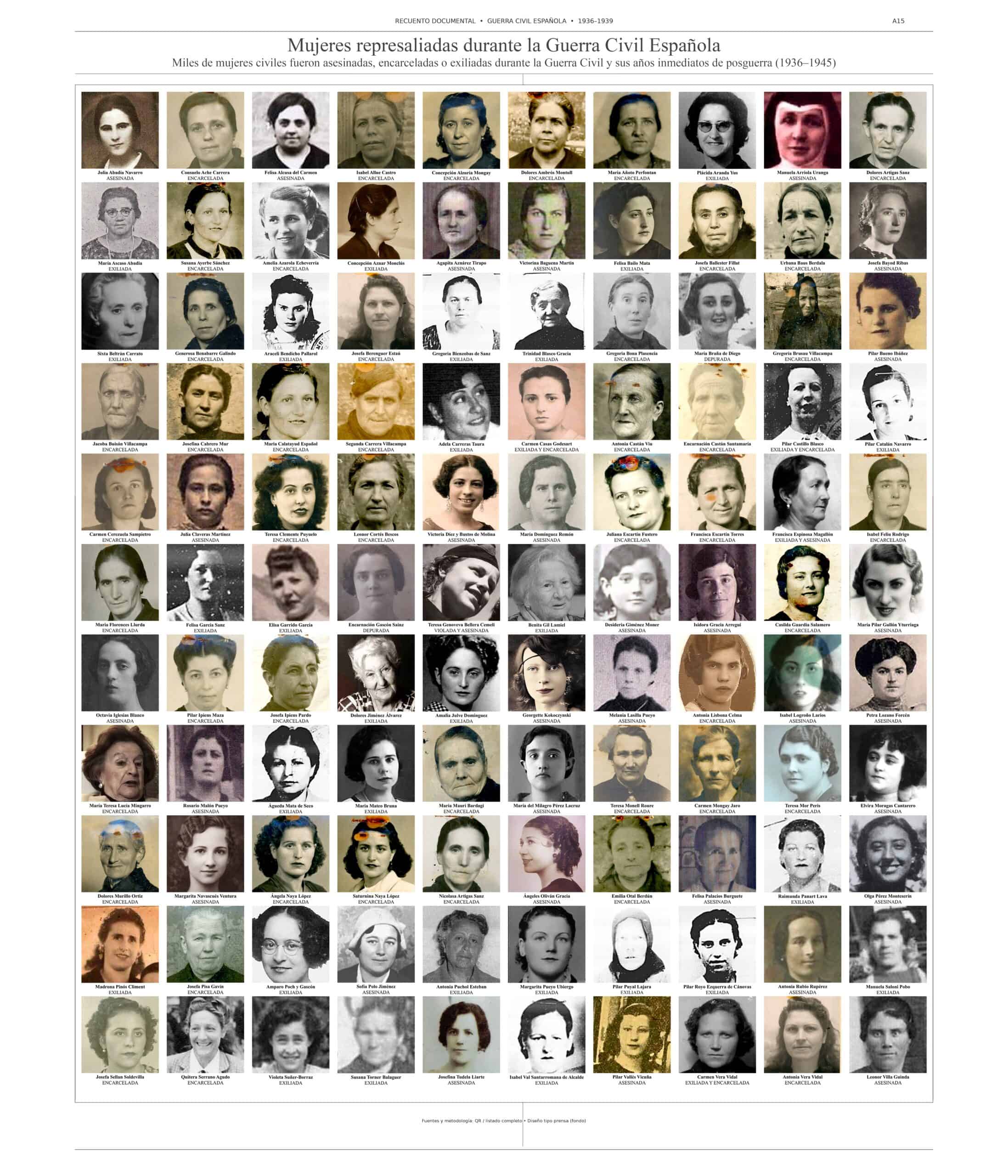
The women's grid.
Faces of women marked by the Spanish Civil War and its aftermath — exile, imprisonment, purges, executions. The names and case notes are compiled from Con nombre y apellidos, a citizen-built memorial archive that gathers scattered records into searchable lists. These databases restore visibility to individuals reduced to files, categories, or silence.
A letter from Mateo
to Enrique.
Arbúcies, Catalonia — undated, autumn 1937. The recipient is in Huesca, a Nationalist-held city under Republican siege. The author is nineteen and not yet mobilised. Between them, six hundred kilometres and a frontline.
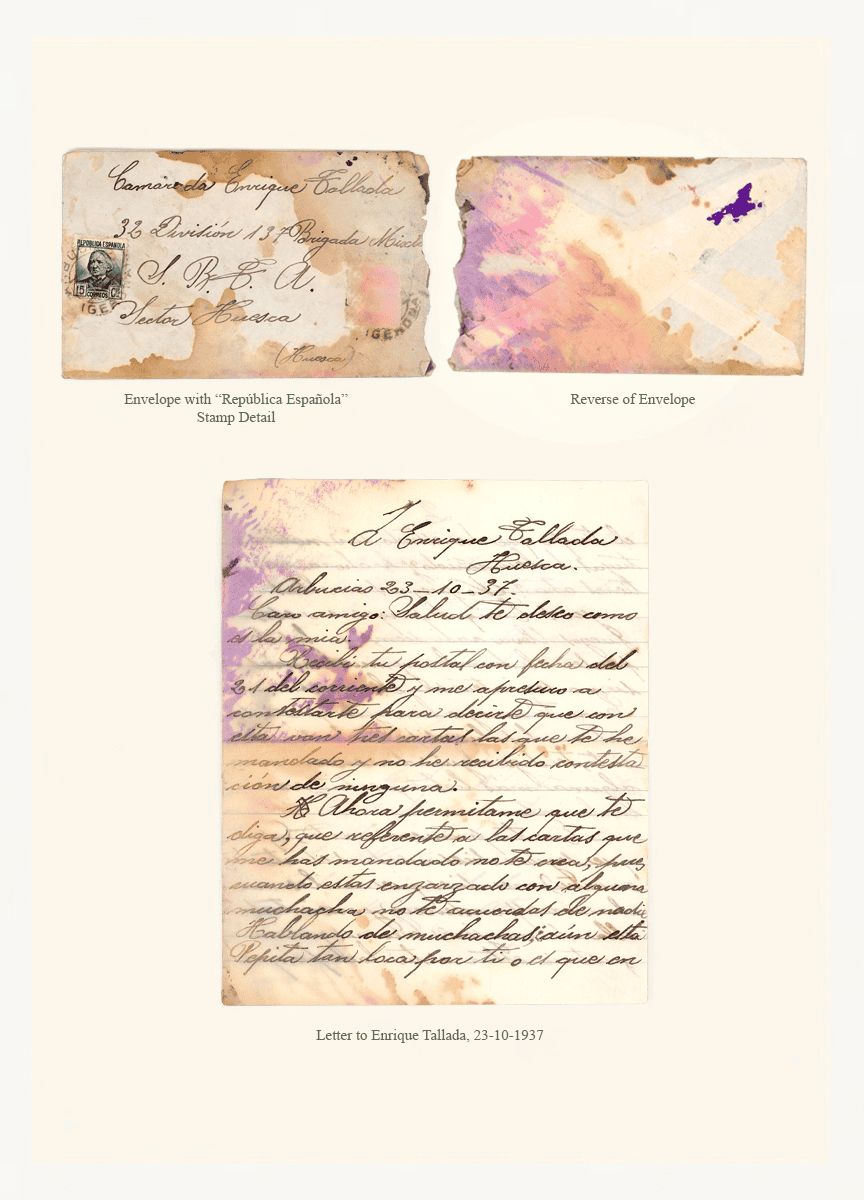
The author is Mateo. He writes from Arbúcies, a Catalan village in the Selva mountains, to his friend Enrique Tallada, in Huesca — a city the war has cut in half. He has written three times and has had no reply. He keeps writing.
He fills the letter with a girl named Esperanza, a refugee from Jaca whose family lost their land when the uprising began. He describes the first time he kissed her. The tears it brought her. His hands wiping them away. By the time the letter reaches Huesca, he already has someone new.
The war does not appear in any of this. He talks about football. About mutual friends. About the daily life of a town not yet at war. He signs off at two in the morning.
Two days before this letter was written, Gijón fell to the Nationalists and the war in the north ended. The Republic was calling up seventeen-year-olds. Mateo does not mention any of it. Why he was still in Arbúcies is unexplained — too young, a work exemption, a draft notice that had not yet arrived.
Enrique's silence is harder to explain. Huesca was besieged; mail out was slow and sometimes impossible. He may have been moved to another position. He may have been at the front. What the letter makes clear is that neither of them had stopped being nineteen.
The war is in every line of this letter, and in none of its words.
This is the kind of source the project keeps trying to recover. The paper that stayed in attics long after the families stopped talking. Letters, passes, photographs with notes on the back, school certificates. The history of the war as a domestic history. The history of the war as the history of those who survived to keep it.
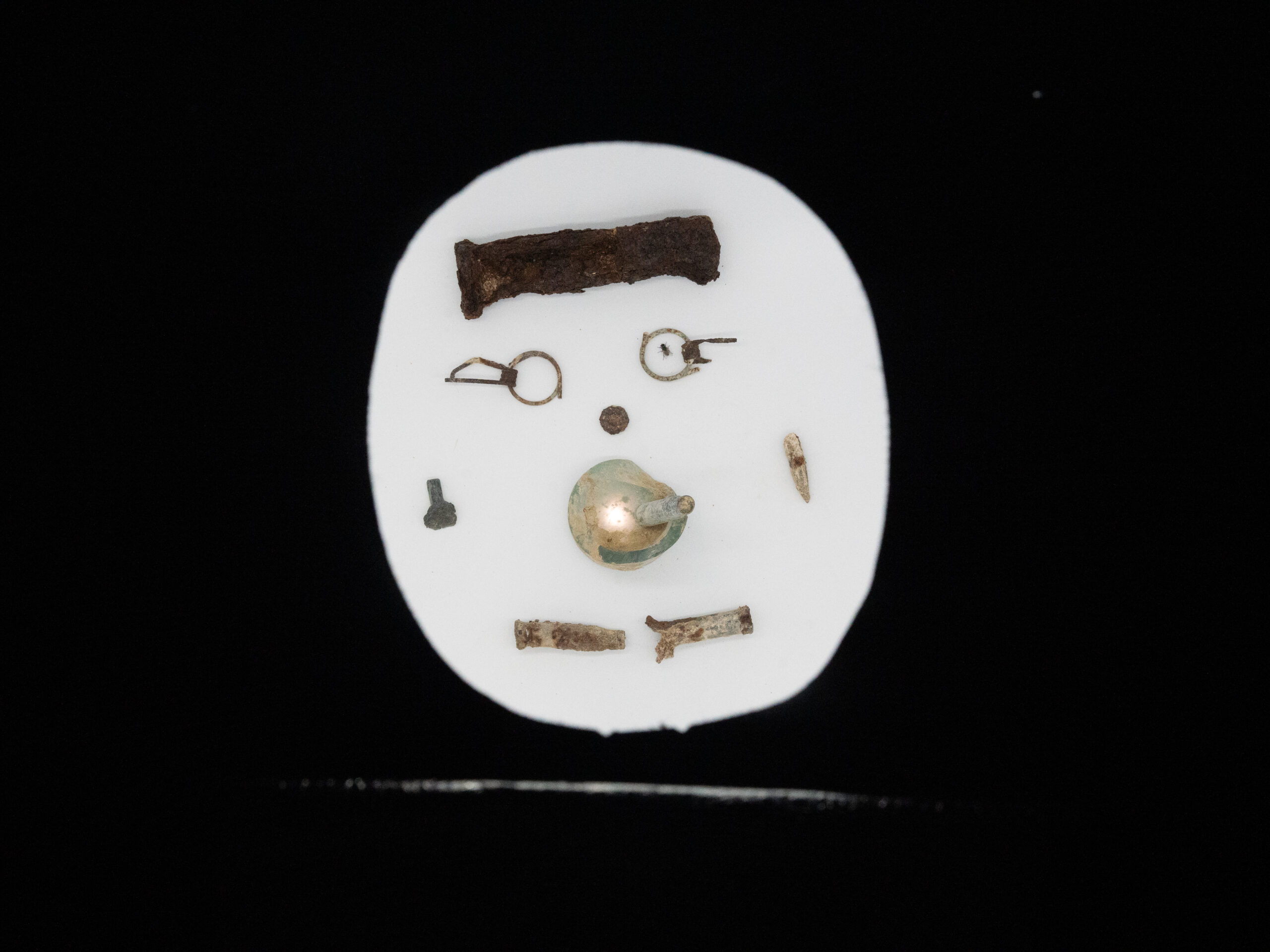
The face of war is a small object. A composition of artefacts discovered by re-enactors during their exploration of the battlefields around Fuentes de Ebro: rifle butts, grenade rings, shell casings, shrapnel fragments, bullets, and the base of a bottle, likely used for wine or medicine.
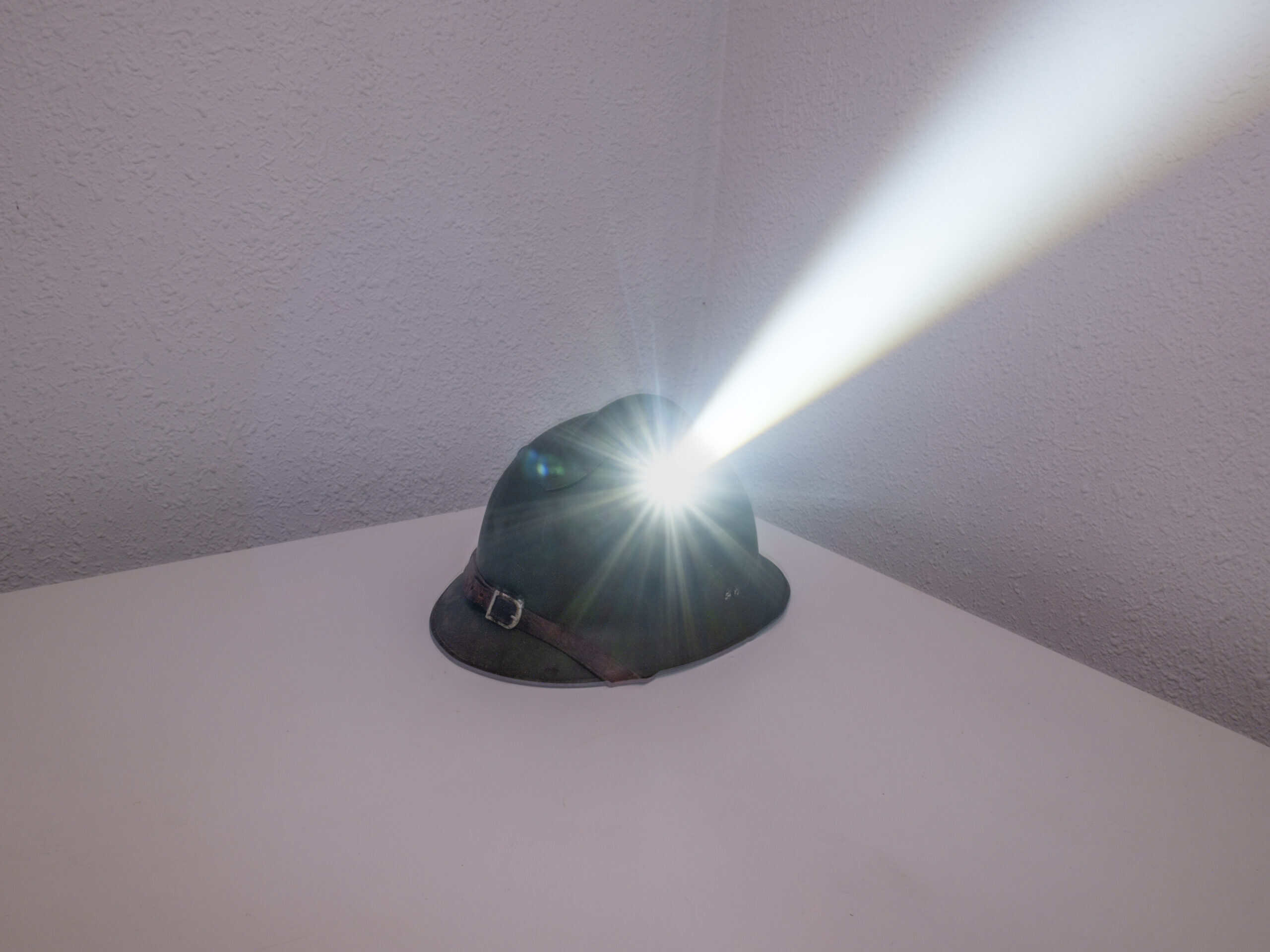
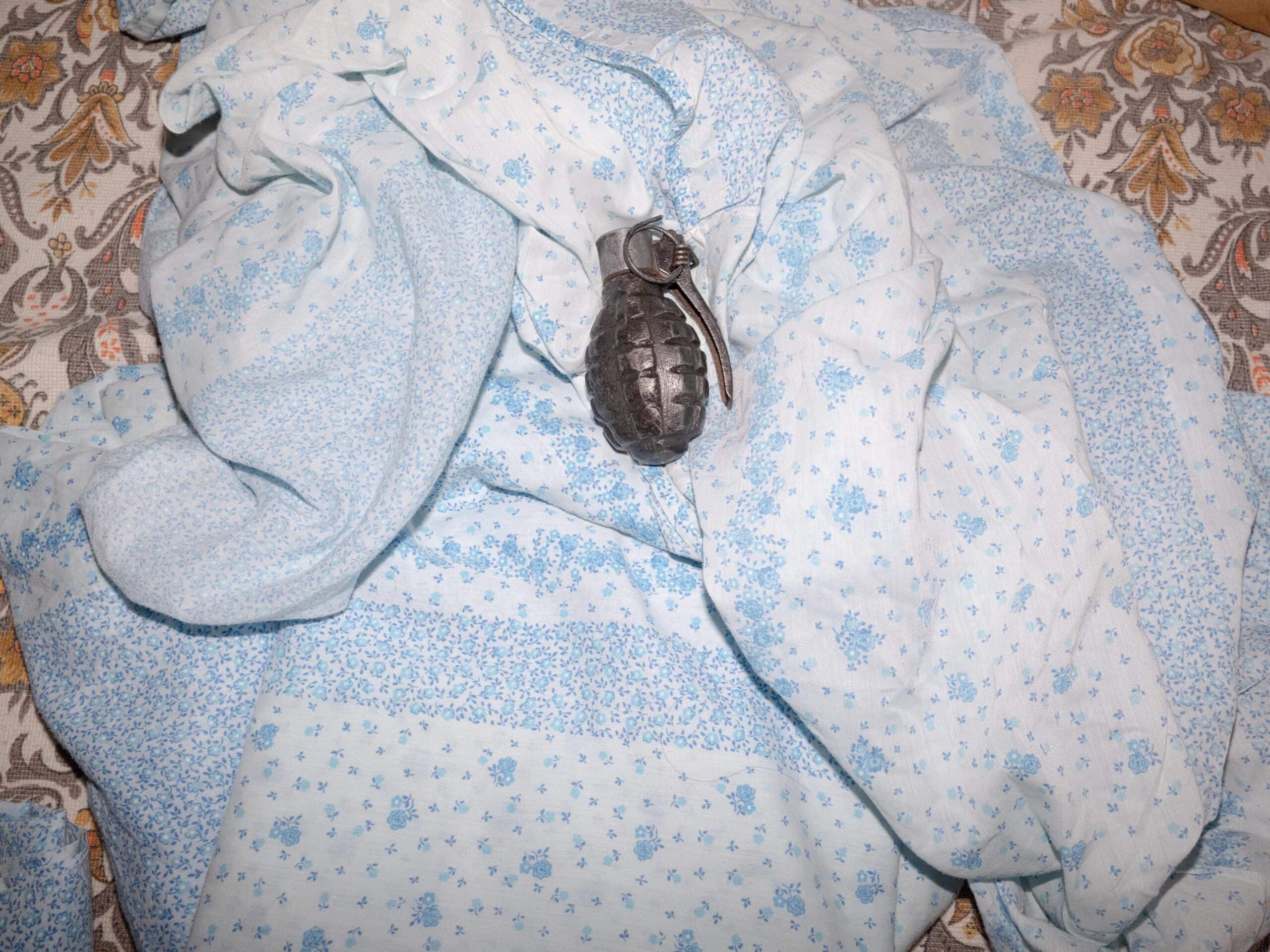
The war the cameras forgot:
at sea.
An album follows one anonymous Nationalist sailor across two ships and eighteen months — Bay of Biscay to Málaga to Palma — photographing the routine of a war whose iconic frames are all on land.
The Spanish Civil War was fought at sea as much as on land. The Nationalist navy, built around the port of Ferrol in Galicia, spent much of the war controlling the Atlantic and Mediterranean approaches — blockading Republican ports, intercepting supply ships, moving troops along routes the Republic could not easily reach. None of it made it into the war's photographic canon. Capa was on the Ebro, not on the Cantábrico. Taro was at Brunete, not at Palma.
A sailor aboard Nationalist warships photographs his voyages. His name is not recorded. What survives are the photographs themselves, preserved by Pablo Gracia, alongside the letters and the school certificates. The prints come with dates and notes on the back, occasionally in the first person.
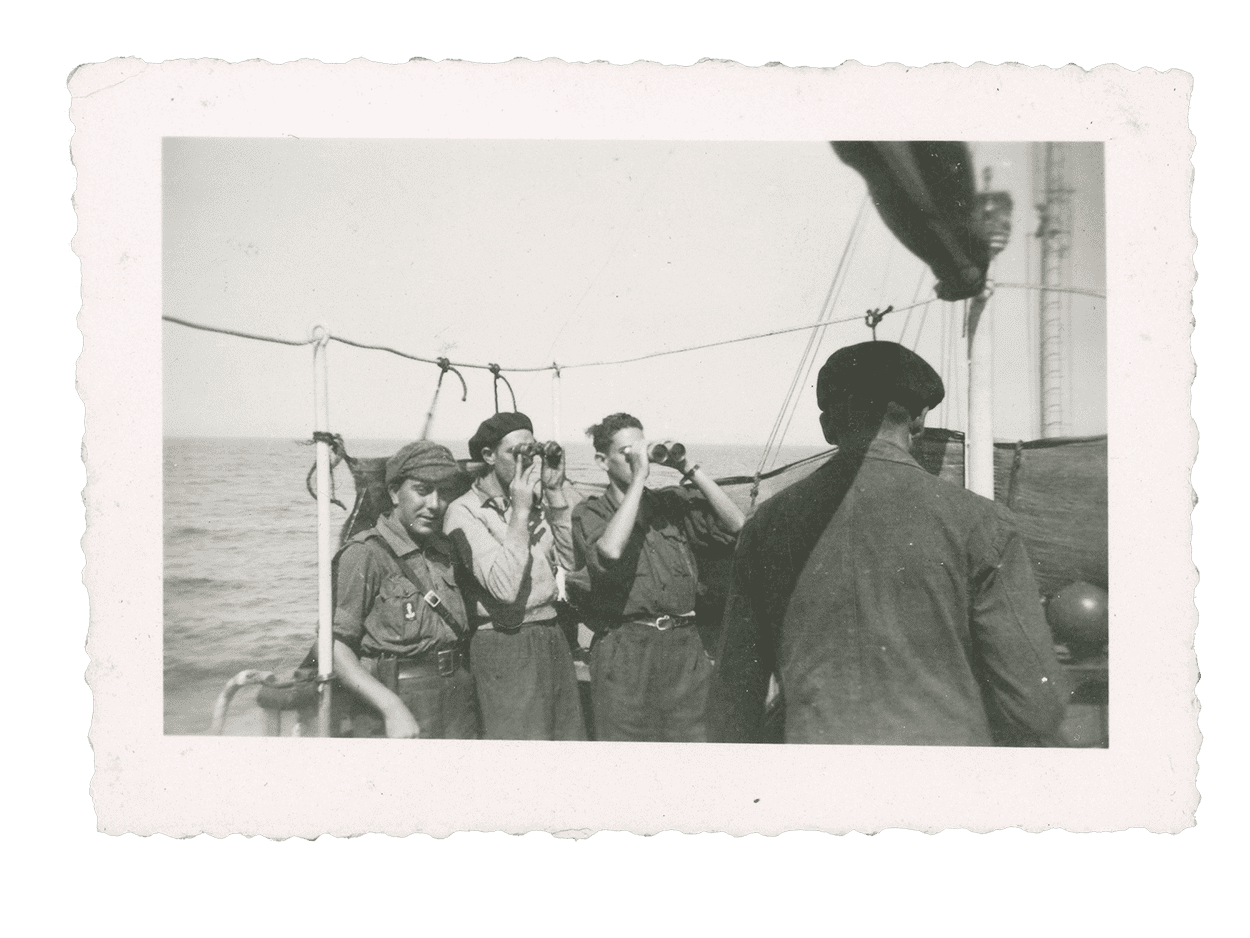
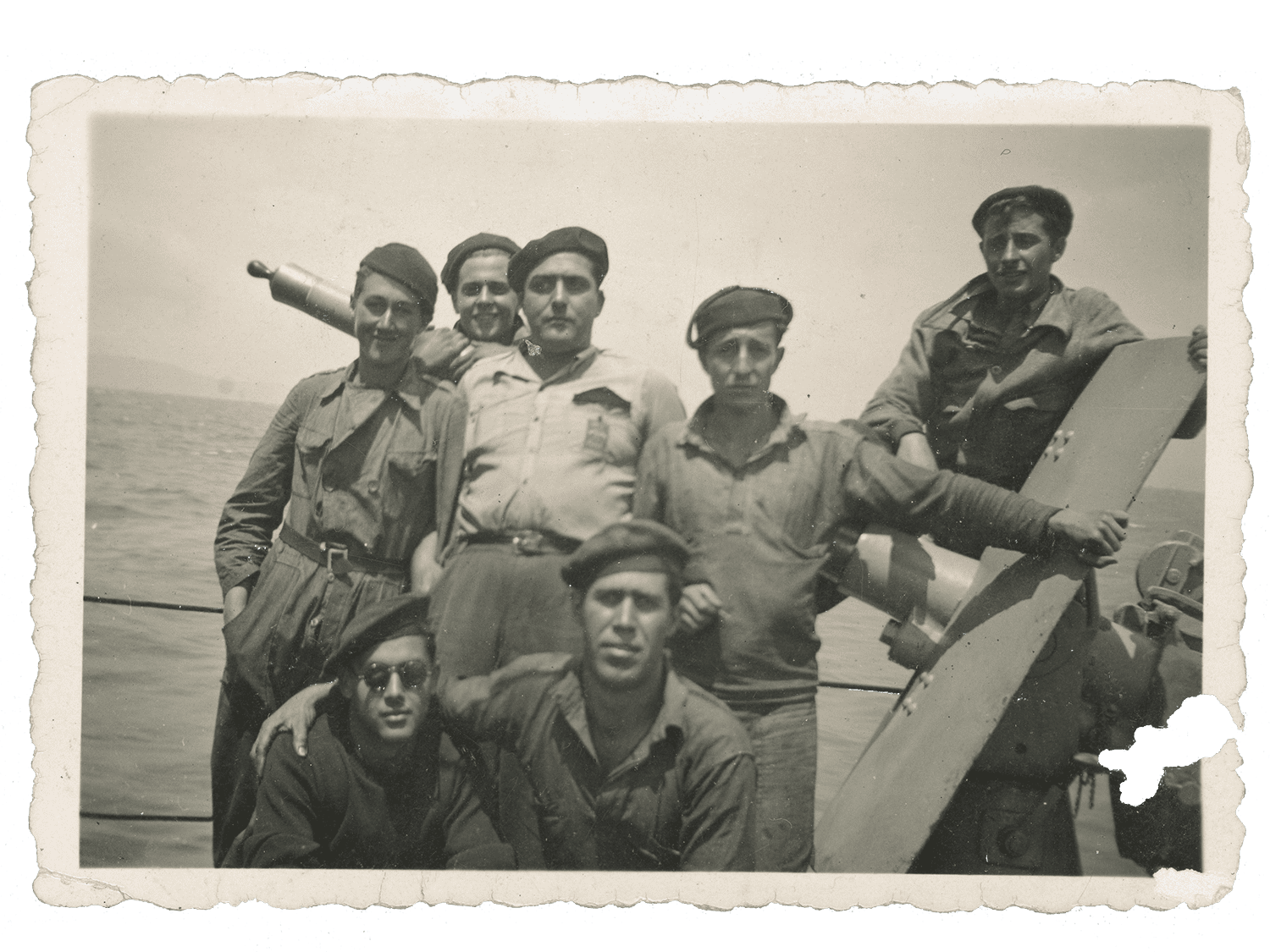
The album follows two ships. The Ferrolano first, a small armed tugboat built in Lytham in 1918 (300 tons, a single Nordenfelt gun), one of the auxiliary vessels that did the ordinary work of the war: boarding merchants, escorting fishing fleets, towing larger ships. The sailor is aboard her in the Bay of Biscay in the autumn of 1937, weeks after the fall of the Basque Country. At some point the album changes ship. The Almirante Cervera, light cruiser, longer and darker, covers the Cantabrian and Atlantic waters in the spring of 1938 — torpedo drills, motor torpedo boats, the minelayer Júpiter crossing his wake, and eventually Málaga.
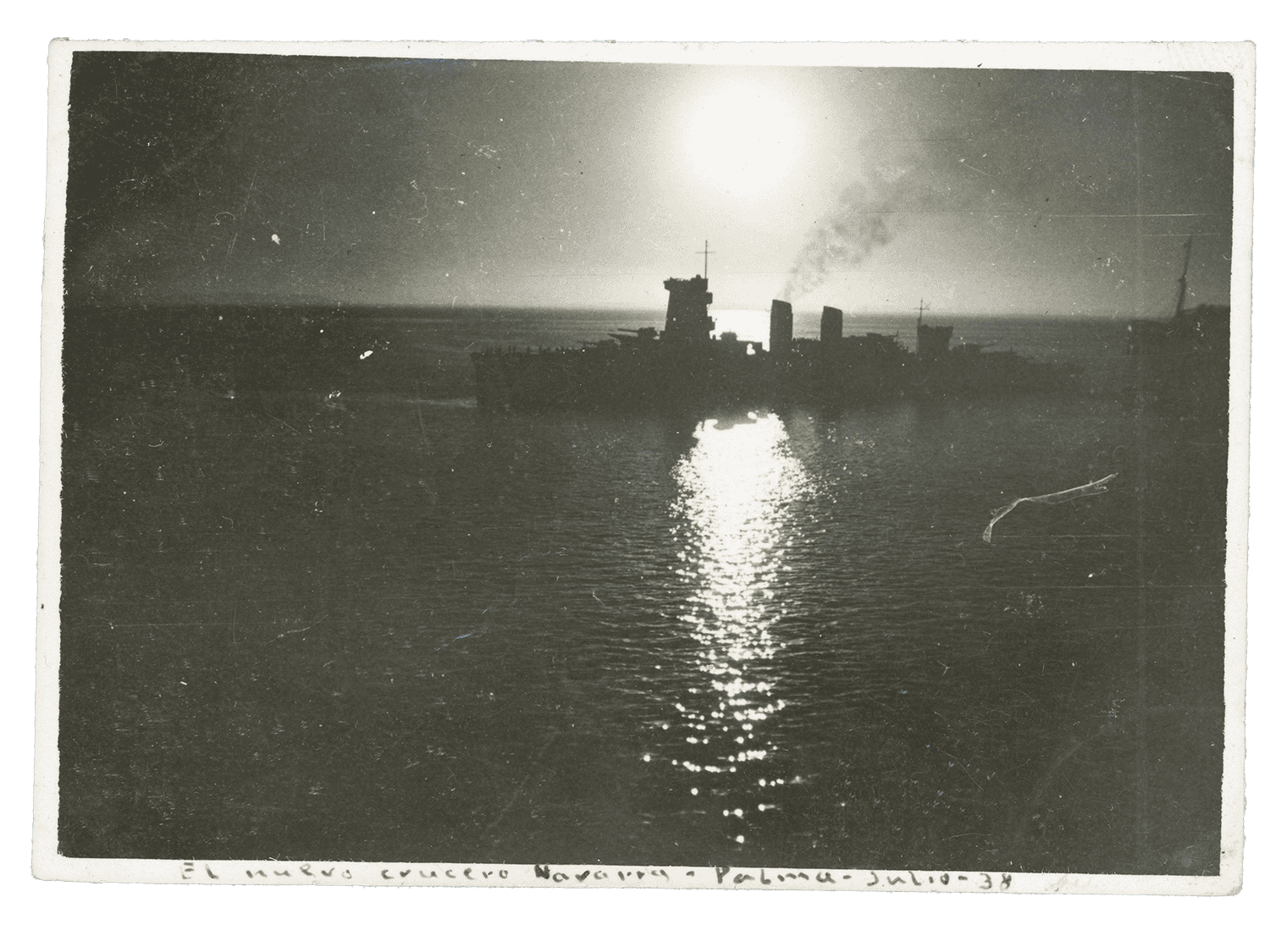
There, eventually, the photographs stop being of the sea. They become of a city. El Palo, the Puerta Oscura gardens, the Apolo baths, the Park. The sailor has time. The ship waits.
What does it mean that the most famous war of photography has these blanks?
— Field note, Ferrol, 2025The photographic canon of this war is overwhelmingly Republican and overwhelmingly terrestrial. The Nationalist navy's archive is partial and dispersed. This album is one of the few first-person photographic records of routine service aboard a Nationalist warship — boarding, dockings, weather, the names of men in a frame. The work isn't symbolic. It is what someone with a camera did with the time he had, between things that were not photographable.
Past · Present
A reading of the project on its own terms.
The project lives in two times at once. On the map, every coordinate carries two photographs: what the cameras recorded between 1936 and 1939, and what remains on the same ground today. The cartography is the engine. The journal is what falls out of it.
The 1936-39 layer is borrowed. The Capa archive at the ICP. The Mexican Suitcase recovered in 2007. Pablo Gracia's shoebox in Aragón. The Biblioteca Nacional de España's photographic collection. Two glass-plate prints inherited from a grandmother in Cádiz. Tárrega's municipal archive. The dossiers of Con nombre y apellidos. The work is to bring these scattered, unequal sources back to the geography that produced them, with neither romance nor distance.
The present layer is mine. The reenactors. The objects pulled from the soil. The empty fields where battles were fought and the busy roads that now cross them. Hemingway's cabin reduced to a wooden frame. Natalia receiving a tin medal at the end of a Sunday performance. The two layers do not "complement" each other. They contradict, overlap, embarrass each other. That is the point.
What does it mean to reconstruct a moment that was already, at the time, a reconstruction?
Robert Capa was never one person. Endre Ernő Friedmann and Gerda Taro shared a name and a credit line until she died at Brunete in 1937. Taro staged the prisoners with raised arms. Friedmann arrived after the Segre crossing. Both photographs entered the canon as documents of what had happened, when they were also, at the same time, performances of it. The reenactors today rehearse a war that was, in some of its most famous frames, already being performed for a camera. We are not the first to play it again.
This is not a project about catching a lie. The lie was there from the beginning, in the act of photography itself — an act of selection, framing, and timing. The project is about understanding what we have built on top of that origin — what a country remembers, how, and who decides — and about putting back, into the public archive, the fragments that private silence has been holding.
No source has narrative privilege over another.
The reenactor's word and the historian's footnote sit on the same page. The grandmother's photograph and the Capa print share an axis. The interview, the object, the soil sample, the bomb fragment — all of them are evidence, and all of them are partial.
This journal is the slow document. The cartographic platform is the live one. The archive on the map →
The archive in the cartography also includes voices and music — pieces of how the war sounded then, paired with the places where they were sung or recorded. Two of them:
The journal you have just read is a slice. The cartography holds points the journal has not yet reached, or only touches in passing.
- Hotel Florida, Madrid — operating base for the foreign press, 1937. Hemingway, Gellhorn, Capa, Taro, Dos Passos, Saint-Exupéry.
- Almudévar / Alcubierre, Aragón — George Orwell's POUM position above the canal. He arrived in January 1937 and saw almost no fighting.
- Miravet, Tarragona — Líster's V Corps crossed the Ebro here in the dark before dawn, July 25, 1938. Capa arrived hours later, "with a Leica and a conviction: fascism had to lose."
- Lopera, Jaén — the first American volunteers, fighting under other flags before the Lincoln Brigade existed. A disaster. The commander was shot by his own side.
- Cádiz — Nationalist port through which Italian materiel arrived while Soviet armour, weeks earlier, had passed bound for the Republic. The seaborne war within the war.
- Gernika — bombed by the Condor Legion and the Aviazione Legionaria on 26 April 1937, a Monday, market day. A full-scale ceramic reproduction of Picasso's mural now covers a public wall in the town centre.
- Mallorca · Son Sant Joan — Italian air base. 782 raids on the Mediterranean coast in the first half of 1938 alone. The same airfield today receives thirty-two Ryanair flights a week.
- Alicante · Central Market — 25 May 1938. Ninety bombs at 11:18 a.m. The single deadliest air attack on civilians in the entire war.
- Málaga–Almería N-340 — La Desbandá, February 1937. Between 100.000 and 150.000 civilians on foot down the coast road, strafed and shelled. Three to five thousand died on the road.
- Torremolinos · airport site — Franco's regime put 4.000 Republican prisoners to forced labour building Málaga airport. The site is now a leisure complex.
- Barcelona, 26 January 1939 — La Retirada. Half a million people on the road to France. The largest displacement of the war.
Each will, in time, receive its own pages here. For now, the map →
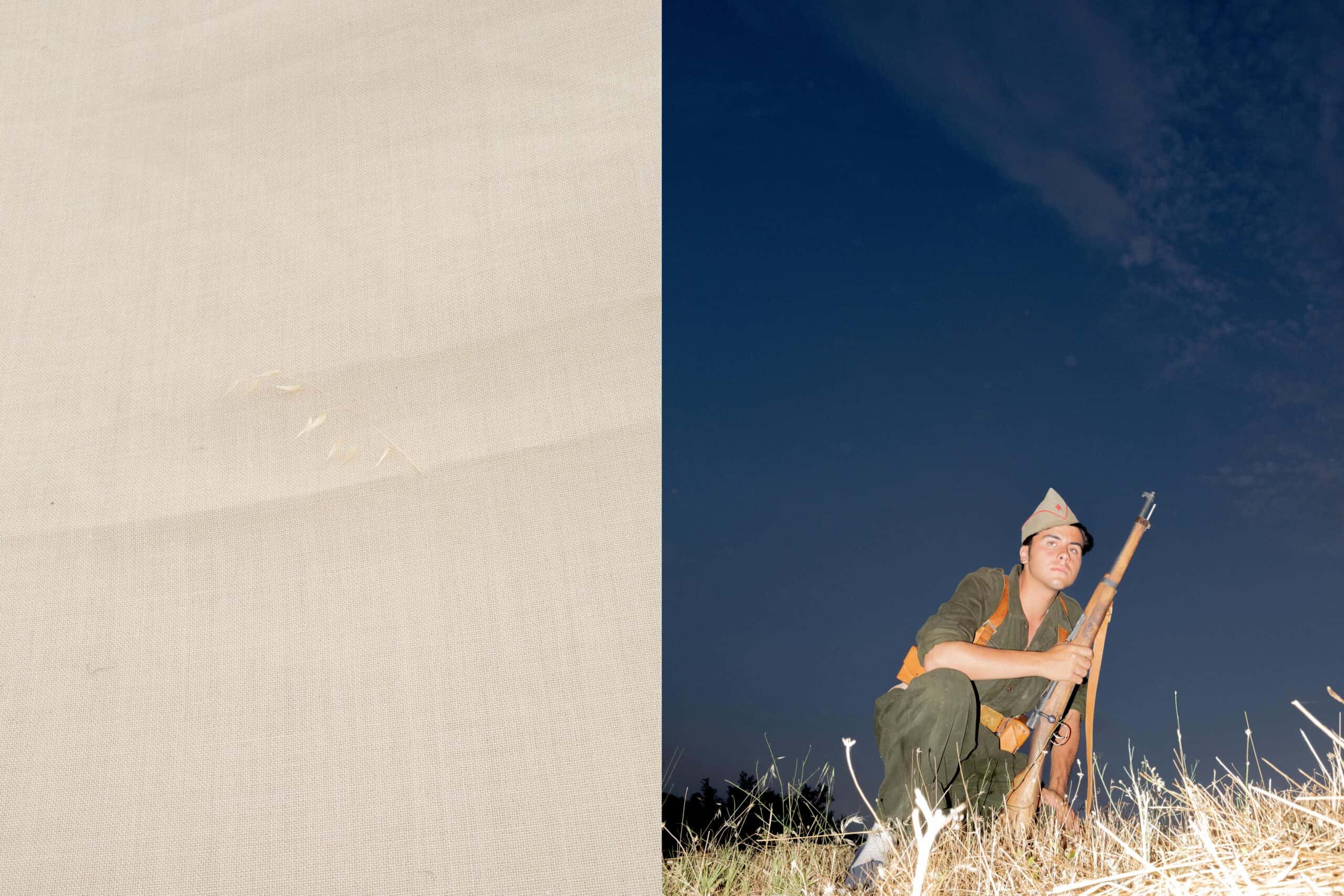
Three battlefields in a fortnight. Quijorna was fought on dry farmland — open fields, dry grass, little cover. Quinto sits on the N-232, the road that once carried the front, and is now traveled by trucks bound for Tarragona. Viver, the third, never happened.
On April 7, 1938, two bombs fell in Tàrrega. One exploded. The other didn't. Josep Flaquer wrote this in his diary as fascist planes flew overhead. The diary is in the project's holdings — on loan, photographed, scanned page by page.
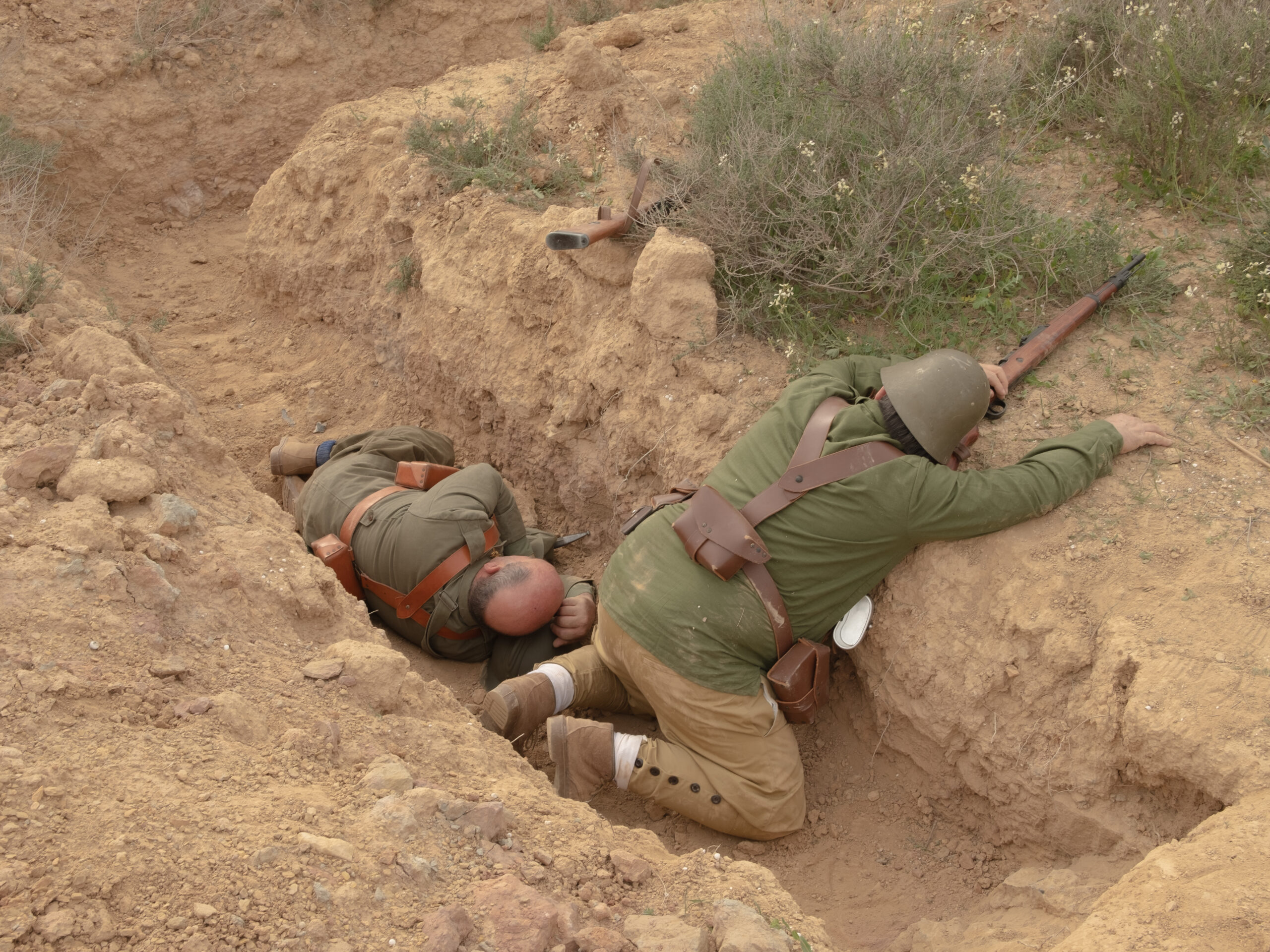
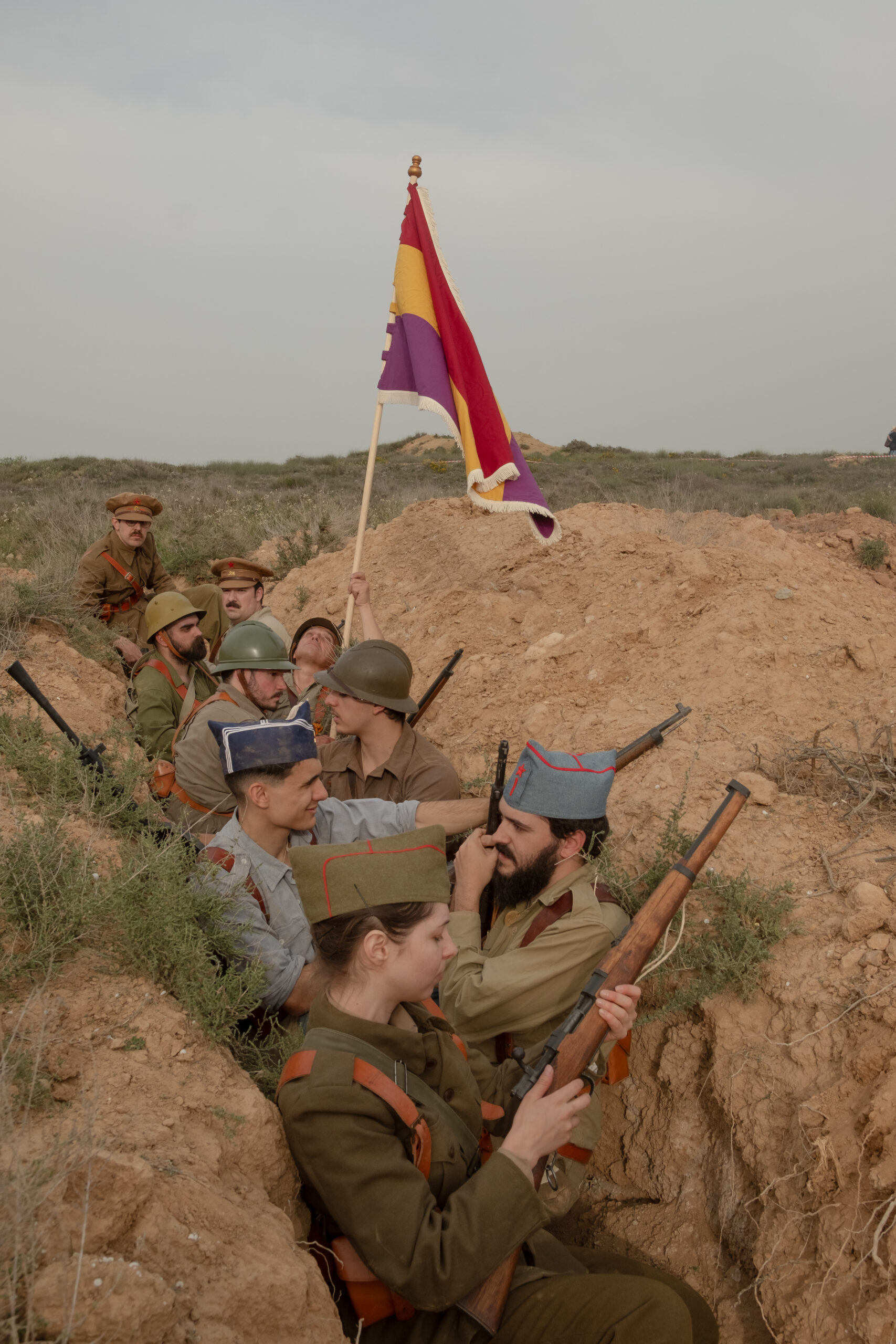
Republican re-enactors in a trench, imitating the situation where Republicans launched an offensive in July 1938. The trench is real — dug for the day, on the same ground. The bullets are not.
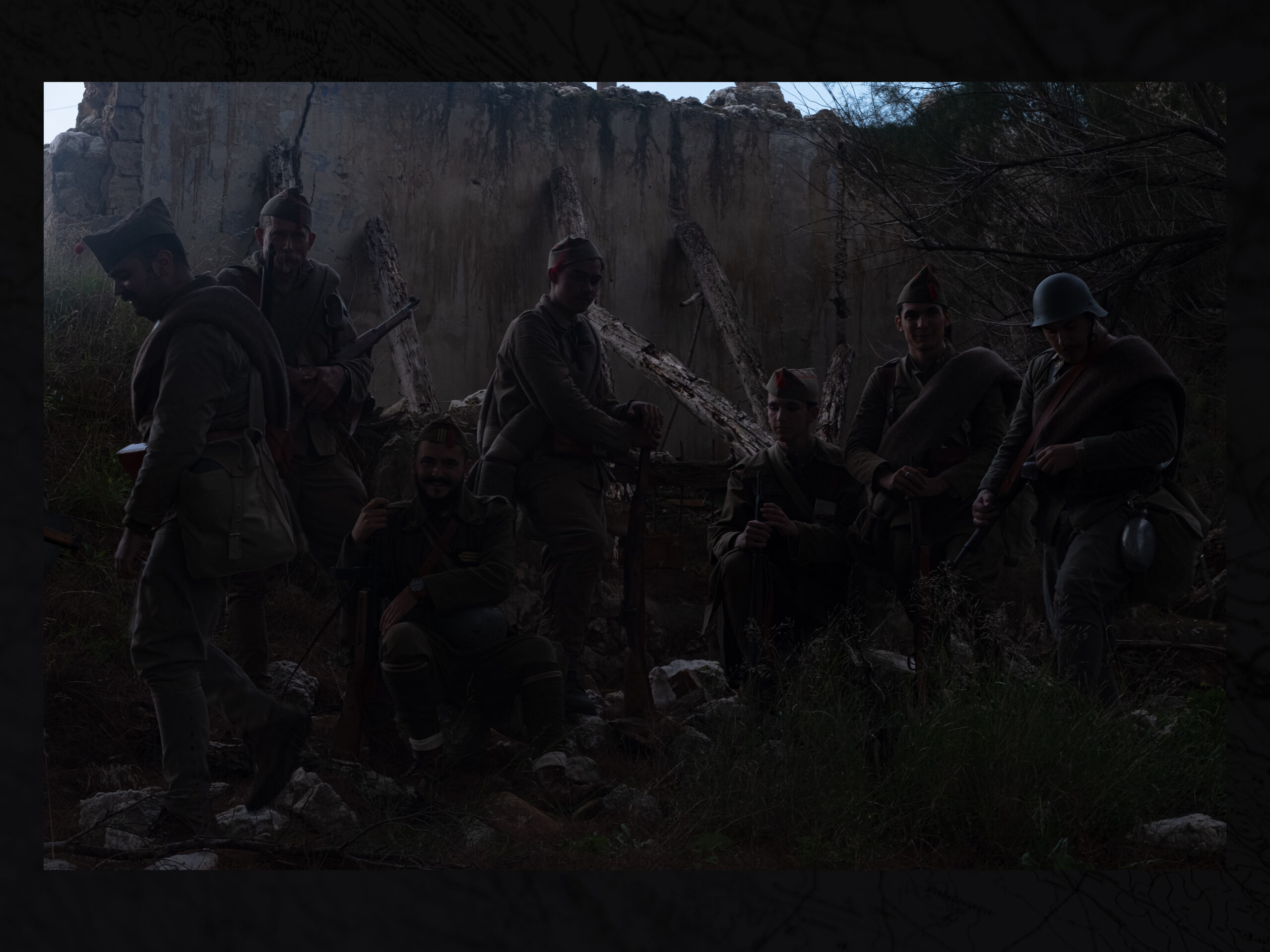
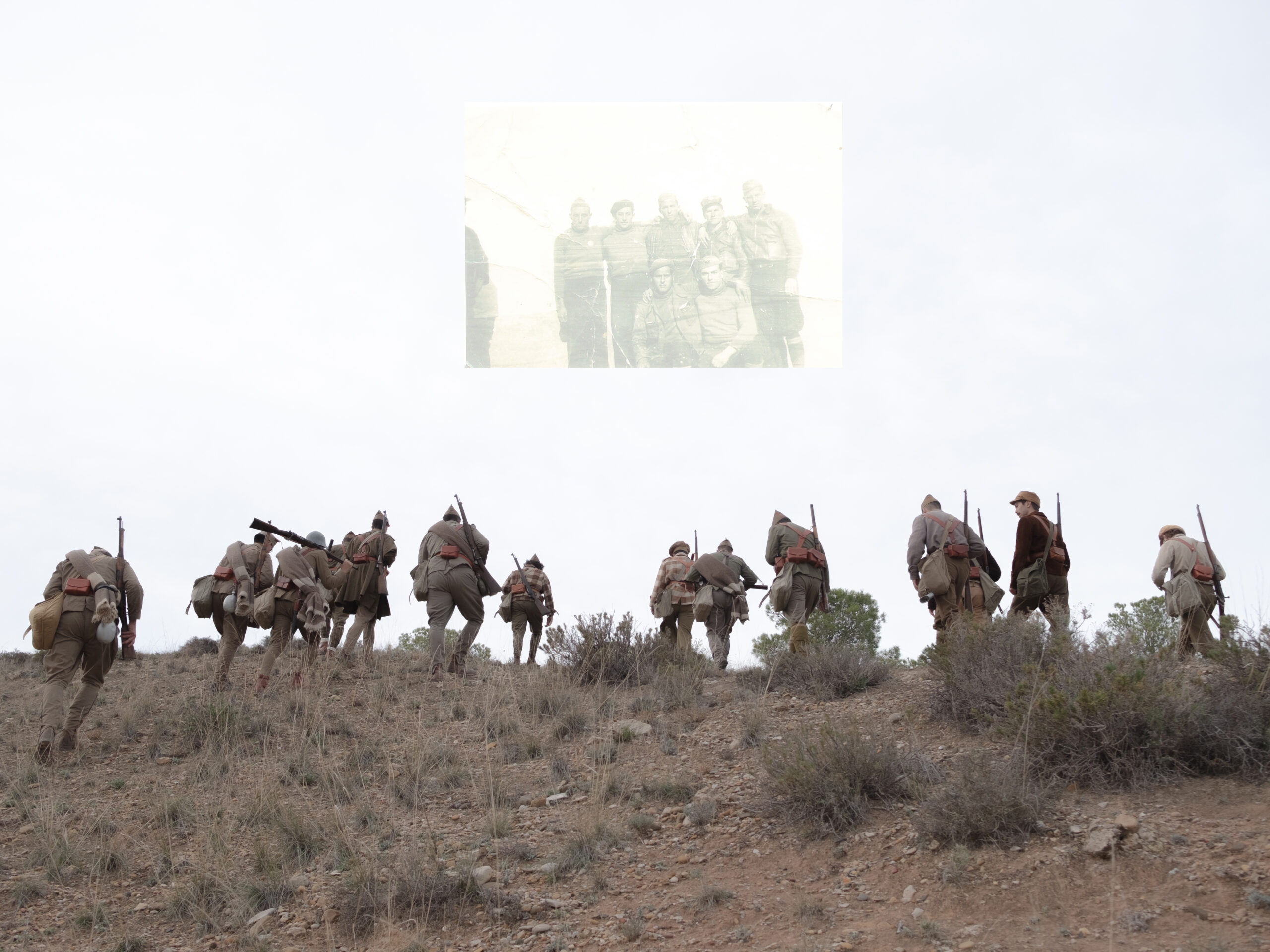
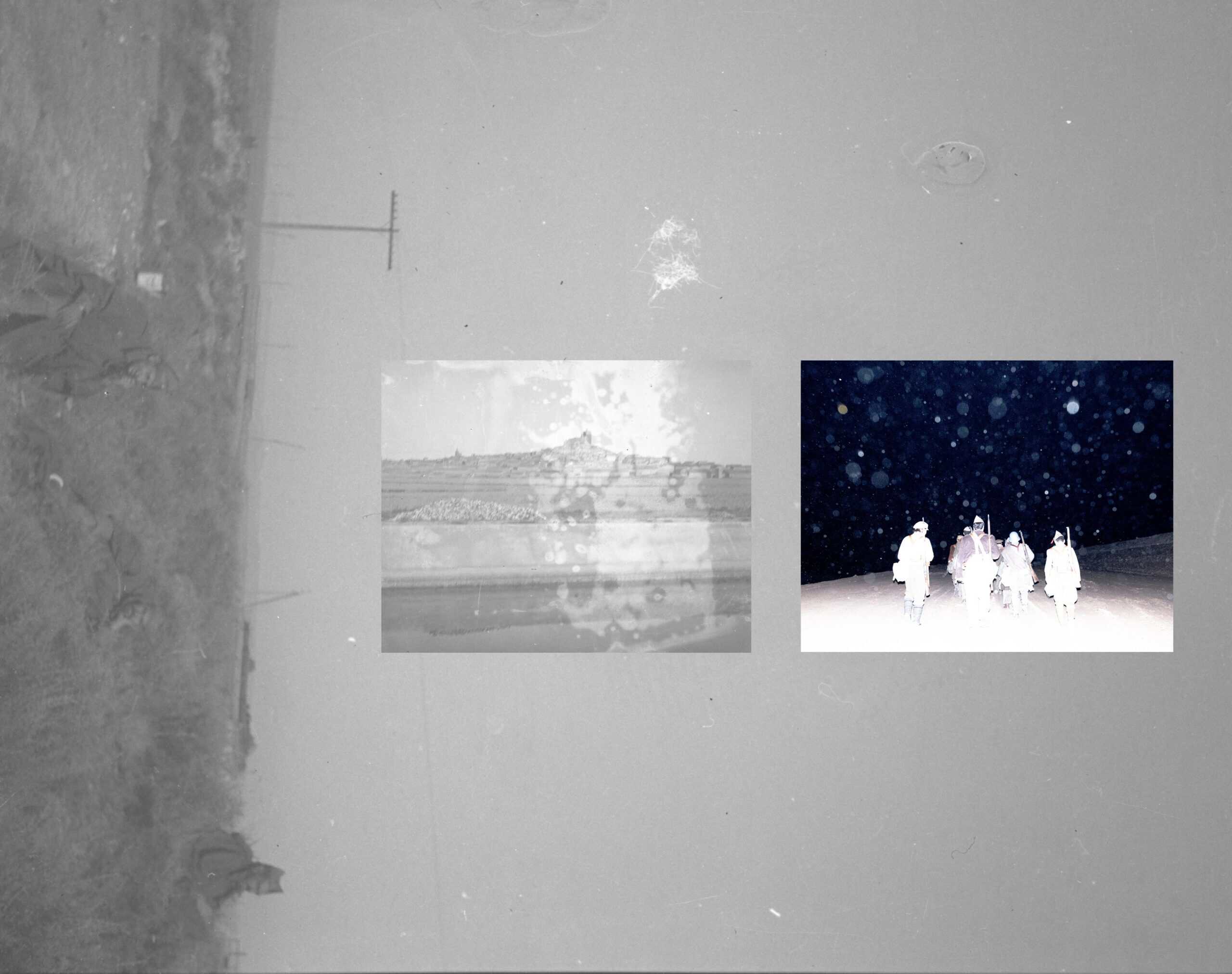
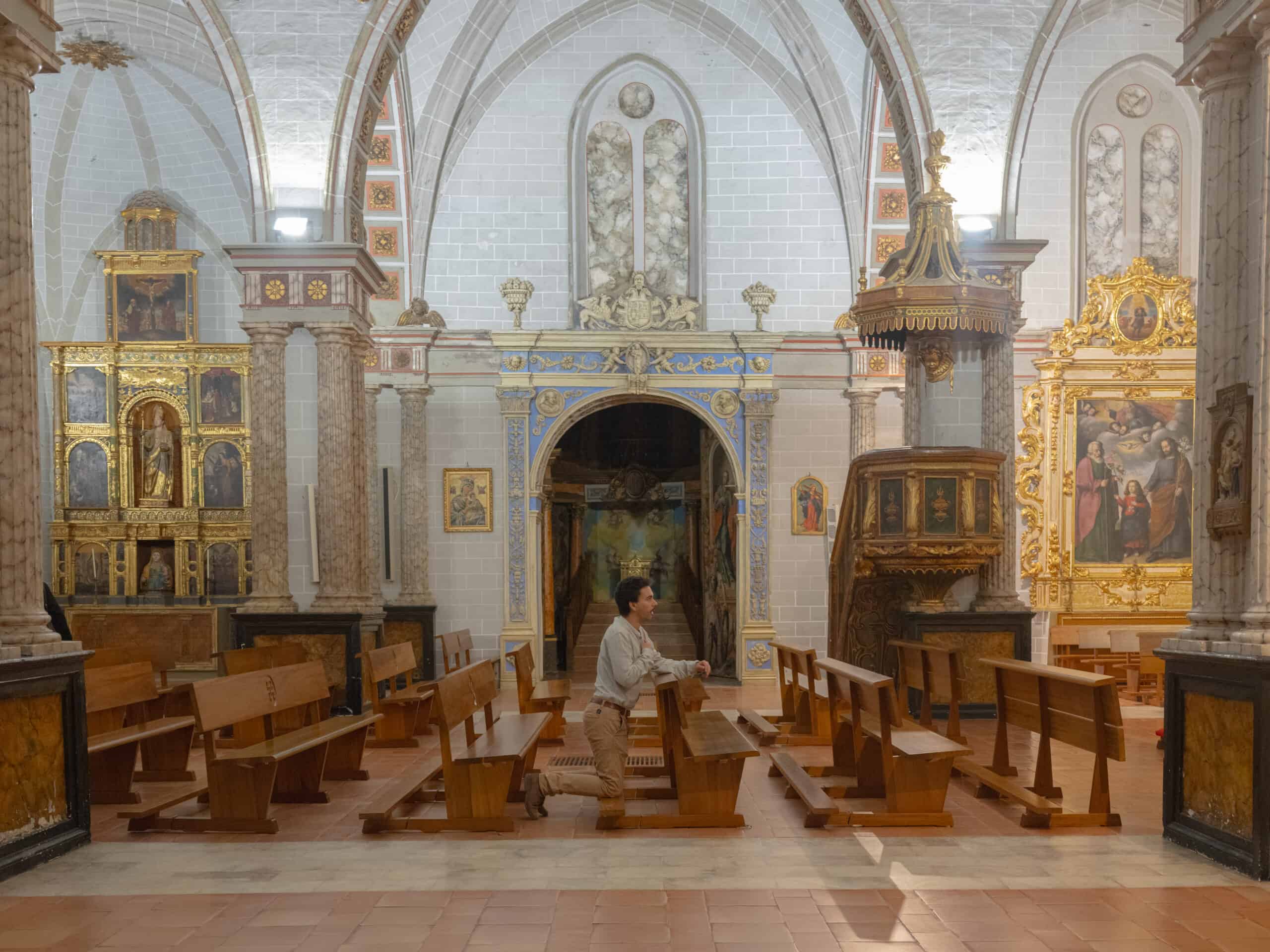
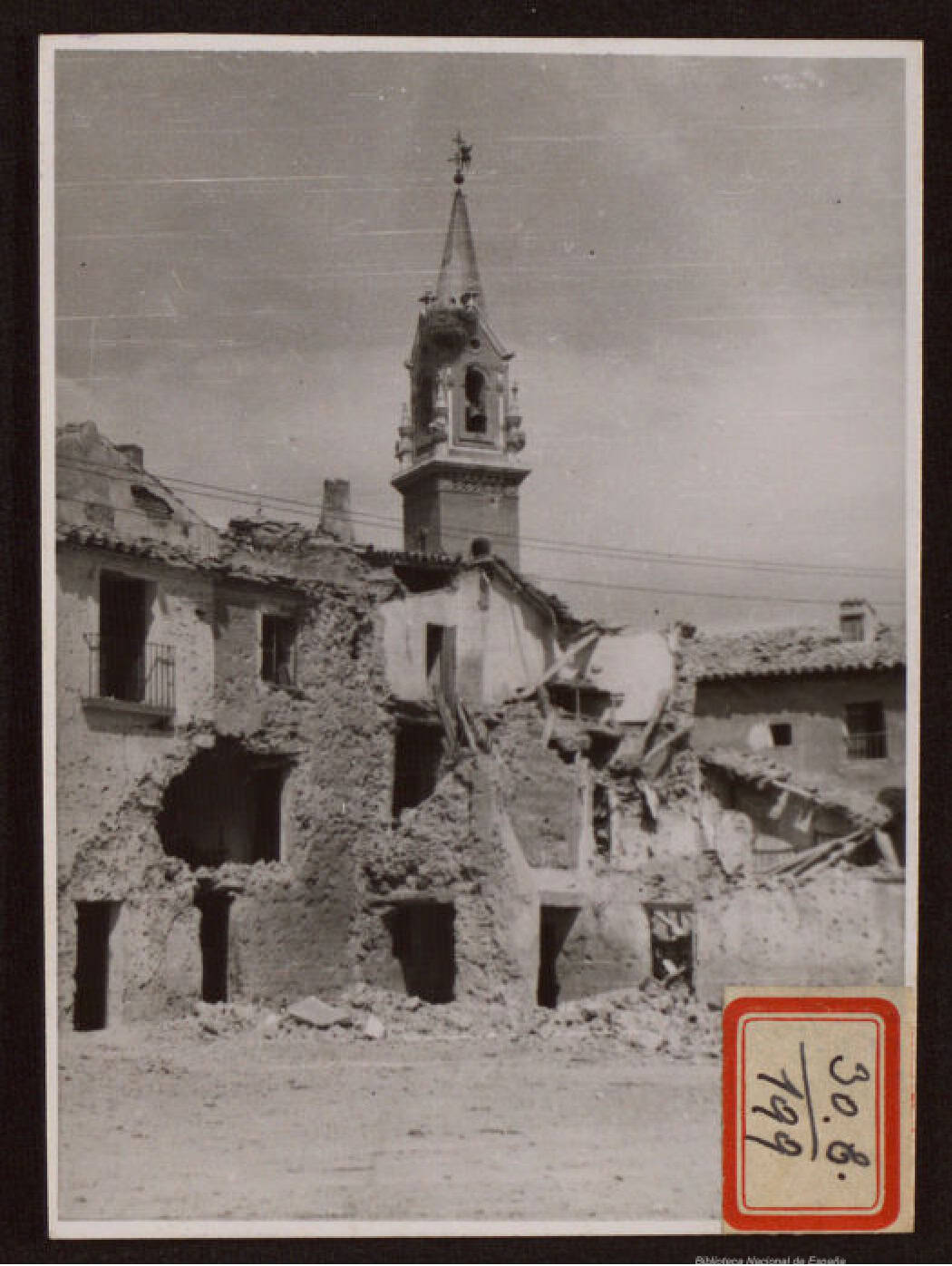
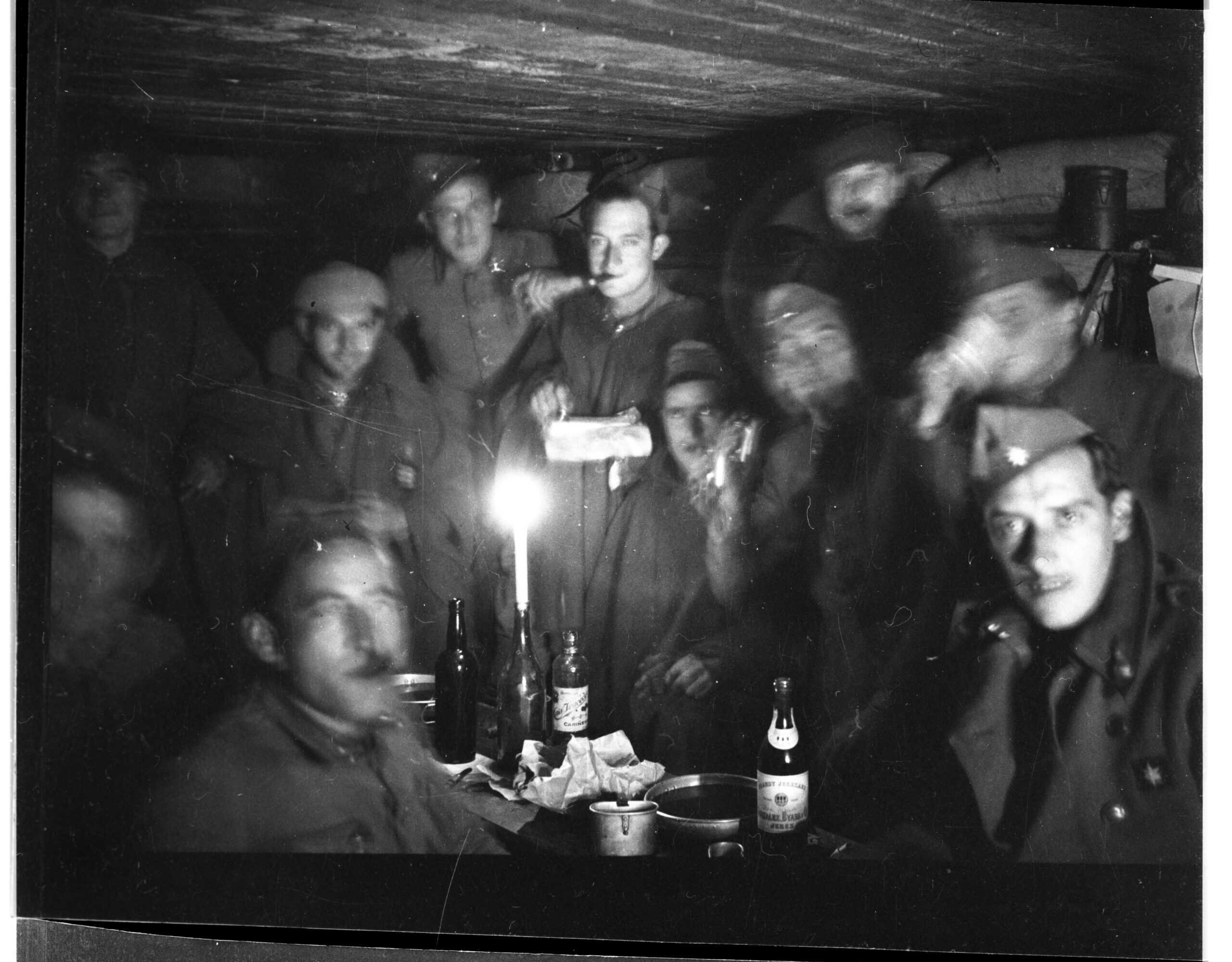
Three frames around the same village. Fuentes de Ebro. A Sunday in 2024 with a reenactor still kneeling after mass. A church tower photographed in 1937, when the Republic launched forty-eight BT-5 tanks at this stretch of the front and lost most of them within an afternoon. And a bunker, weeks after that defeat, where soldiers improvised Christmas by candlelight. Within a year most of them would be dead, prisoners, or in exile.
The tower in the archive is the same tower the reenactor leaves behind when he walks out of the church. The bunker is somewhere under the wheat now, undiscovered or unmarked. The project keeps insisting: this is the same ground.
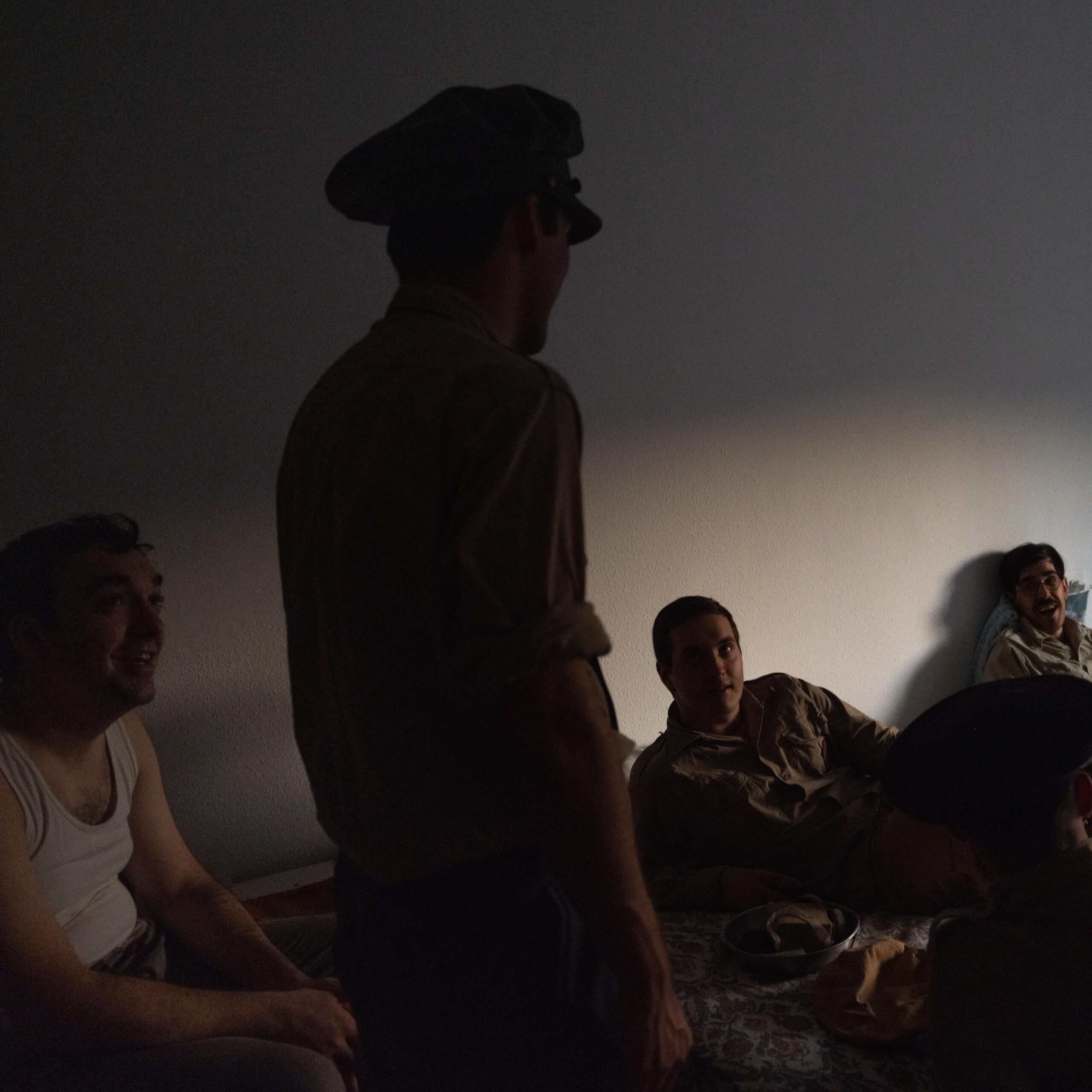
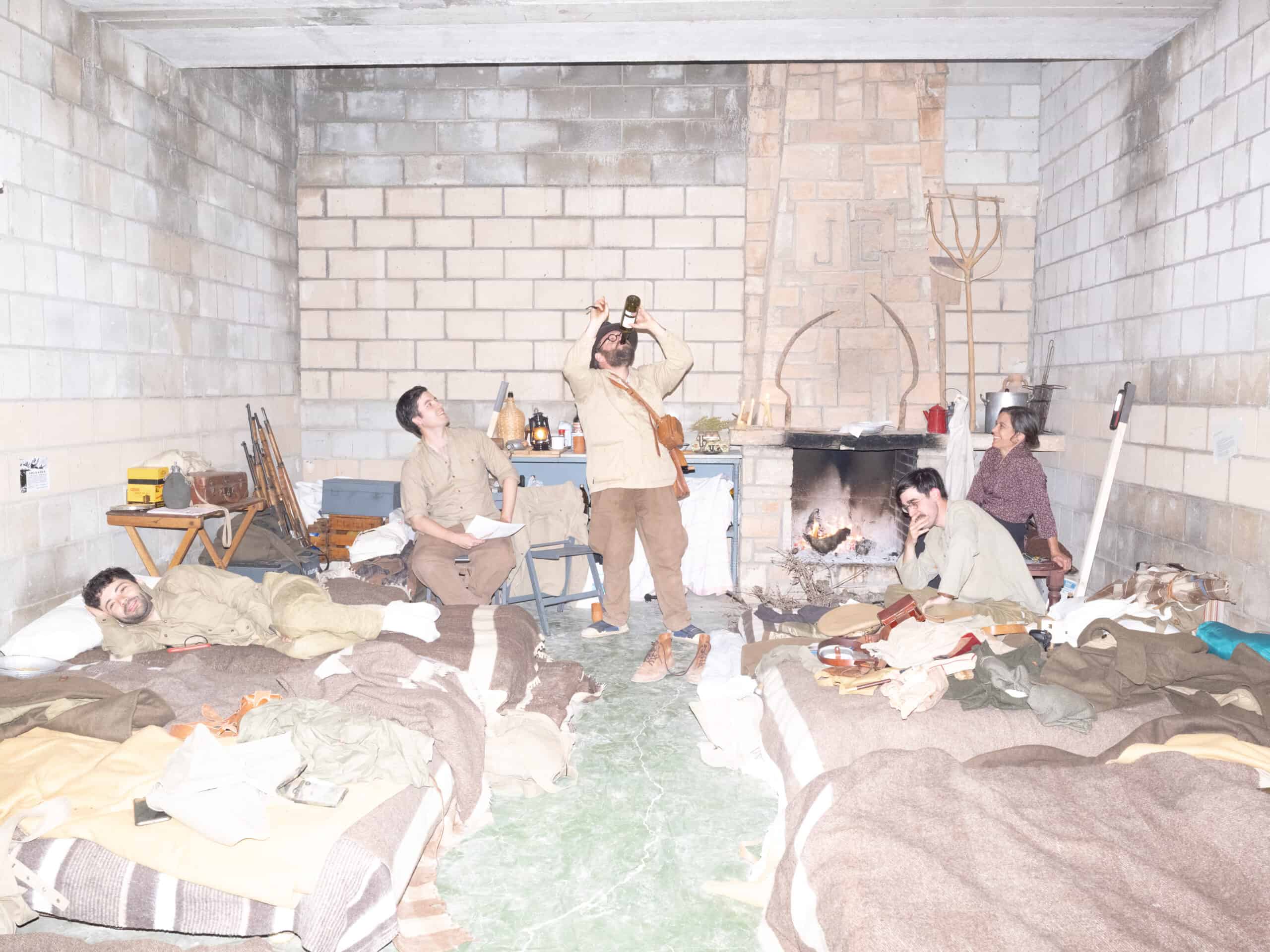
In a cabin ringed by trenches where soldiers once slept, they borrow a night from the dead. He lifts the bottle. "I love the Spanish booze!" Hemingway laughs — half joke, half shield. A contest of uniforms, as the soldiers once held. The room answers with laughter, smoke, and a cheap truce. Outside, the war waits at the door like a dog.
Hemingway files the dispatches from there. NANA, North American Newspaper Alliance. They are reprinted in American kitchens that summer. The captions to Capa's images are his, in the declarative register he used at the front — short sentences, professional distance, the affectation of a man who has decided to sound like a man.
"They go forward in the ultimate loneliness of what is known as contact."
"The close ones have a zipping whisper and the really close ones crack."
— Ernest Hemingway, Madrid front, 1937Eighty-seven years later, in a cabin in Aragón, Sean Edwards in a beard plays the man who wrote those lines. The cabin is not the Hotel Florida and the bottle is not Hemingway's, but the gesture is the same. The foreign correspondent who is also, in the same breath, performing the part. The performance is older than we think. The war taught us to make it.
You arrive from Murcia on the N-340. On a wall at the entrance to the village someone has painted two men. One wears a crown and holds a writing quill. The other, a turban and a silver dagger. A sign reads Monteagudo, frontera de reinos. Above the rooftops, fourteen metres of Christ on an iron frame, and under the Christ an Andalusí fortress of the eleventh century. Ibn Mardanish, the Rey Lobo, ruled the taifa of Murcia from 1147 to 1172 and made this rock a line of defence. The water he ordered still comes down the same canals.

It is the second Christ to crown the hill. The first, a Sacred Heart by the sculptor Anastasio Martínez, was inaugurated on 31 October 1926, under the dictatorship of Primo de Rivera. Twenty tonnes of sculpture on the fortress of the Rey Lobo. It lasted ten years. In September 1936, with the war already on, the municipal plenary voted its demolition, and the blast came on 24 November. They dynamited it with cables that pulled it backward, so it would not fall on the village, and when it fell it broke through the vaults of the rooms below. The second was inaugurated on 28 October 1951, in full Francoism, on the same spot, the work of Nicolás Martínez Ramón. The son made what the father had made. The first was paid for by a subscription among the neighbours; the second, fifteen years after the blast, by another subscription and money from the institutions.

In 2010 the lawyer José Luis Mazón took the Christ to court. The idea came from his son, who was fourteen. The European Court of Human Rights had just ruled against crucifixes in Italian schools, and the boy pointed at the hill across from them. "Pues eso que tienes allí está en el mismo caso." Mazón filed two suits. The first argued that a religious symbol cannot sit on public ground in a non-confessional state; it was dismissed, and the Supreme Court confirmed the dismissal in 2013. The second invoked a Francoist decree of 1949 that prohibited building anything on top of fortresses — the Christ of 1951, he argued, was illegal even under Franco's own law. The Supreme Court declined to hear it. He lost both, and paid for both. Graffiti with his name and the word muerte. Clients who stopped calling. The wound, he says, has closed. "No es ninguna espina pendiente, es una espina que ya se ha secado."
The priest, Carlos Casero, answers those who call it a Francoist symbol with the calendar. "En 1926 no había franquismo en España." The lawyer answers with another calendar — Primo de Rivera, a confessional state, the reserva espiritual de Occidente that Franco would later absorb. And an intention. "Se colocó sabiendo que la fortaleza era árabe, para decir que los cristianos estamos por encima de los musulmanes."

María Dolores was born beside the Corazón de Jesús in 1955, four years after the second one went up, and has spent forty years behind the counter of her kiosk. She sleeps by a window; when she turns over in bed, she is looking at it. When the lawyer tried to remove it, she was the one who took a loudspeaker to the church door and collected the signatures.
The job that Eva Nicolás's father held in the lemon groves is held today by Abdul Adel. One was born in the village, the other in Morocco. Her father worked those trees beside a Moroccan day labourer for years. "Mira, mi moro," he would say. "Mira, mi cristiano," the other answered back. Abdul arrived in the last years of the peseta and has spent more than half his life here. He fumigates, prunes, handles the machinery, and keeps a few goats. He names the plants in his two languages, the hierbabuena that is naná, the timija that is his thyme. He prays five times a day, and when asked where Mecca lies, he points to where the sun rises and corrects a little to the right. The acequia that waters the huerta is the saqiya of Morocco, two forms of one word. The canals were traced by people who prayed as he does, before there was any Christ on the hill. The Christ does not weigh on him. It is up there, and he prays below, facing the sun.
This summer, the night Morocco beat Holland at the World Cup, a dozen young men went up to the mirador with a loudspeaker. The Christ was directly above them, arms open. Chaabi, the party music of their parents' country, and video calls with the ones far away. They are from Oulad Youssef, a rural commune in the province of Beni Mellal whose name means the sons of Youssef. Rayan lives in Milan. Wassim was born in 2005, passed through Madrid, and pays two hundred euros a month for a shared room in a house in the huerta.

One evening, after the cachimba, they guide the way up, past where the fence ends, over the loose stones. "El Cristo es de los españoles de aquí," says Wassim. Everyone here has gone up once. María Dolores went up and has not returned. Pepe Sanz, who is eighty-nine, climbed as a boy through the hollow inside of the figure to the head, and sees no reason to go back — he sees it every day from his patio. Mazón jumped the fence with some local kids. The priest says no one may go up, and in the middle of the conversation looks at the hill. "Mira, ahora mismo hay gente." It is Rayan and Wassim. In one of the vaulted rooms, names from decades ago are scratched into the wall, Fernando, Pedro, Ismael, Anas. Theirs are not there. "¿Y para qué?" says Wassim.
The head of the first Christ stayed at the top, behind the second, face down against the ground, with the marks of the picks that broke it. This autumn it will be ninety years there.
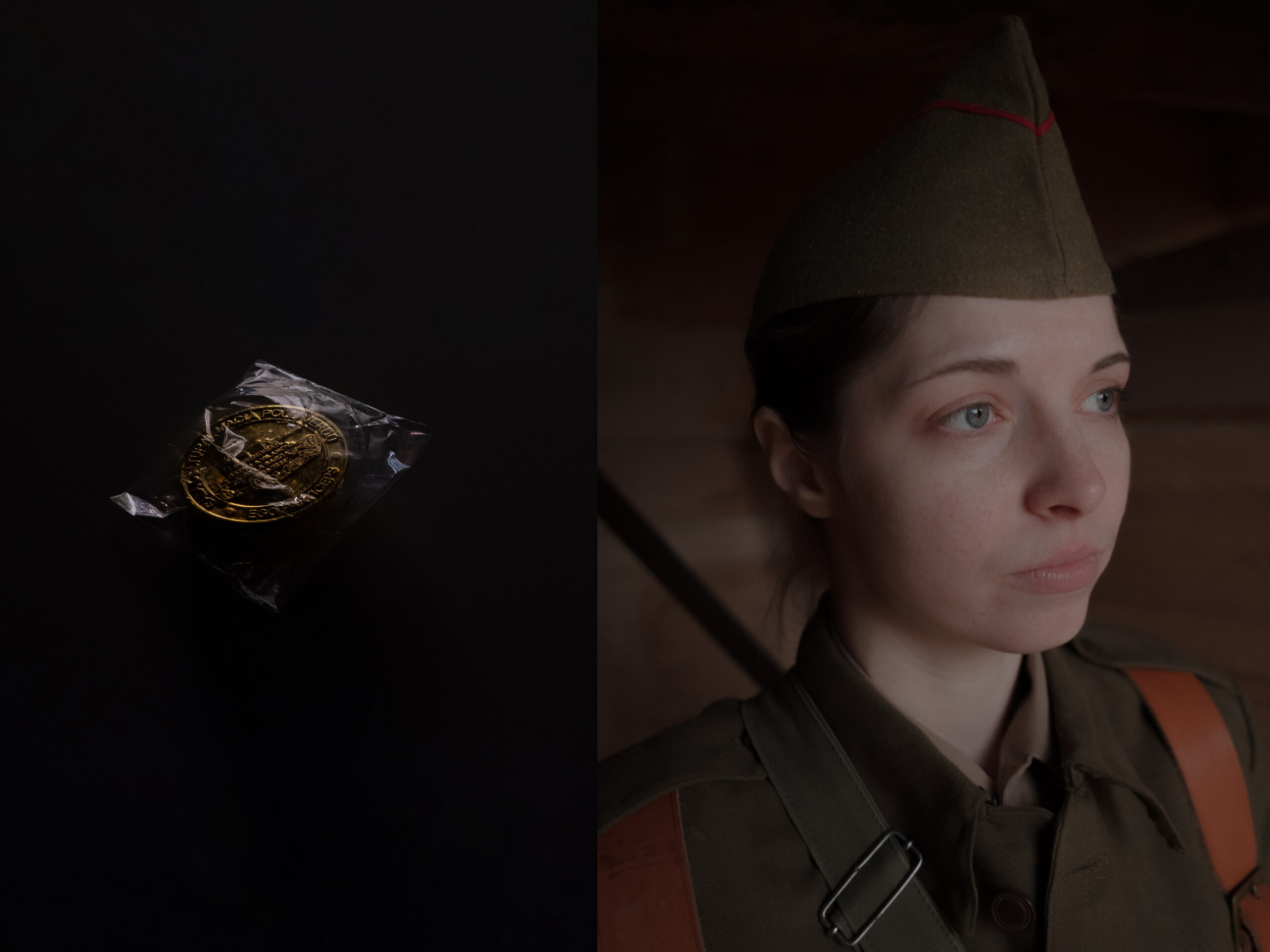
"You were the war photographer today; you deserve the medal."
Every participant in the battle reenactment received one. Natalia's portrait closes the journal. Her medal — paper-thin tin, hand-stamped, weight of nothing — is the inverse of every medal the war once handed out. This one says: you survived a play.
The thirty-three plates, in one place.
010203040506070809101112131415161718192021222324252627282930313233What this journal is.
Field reporting has been conducted across Aragón, Catalunya, Castilla-La Mancha, the Madrid region, the Comunitat Valenciana, Murcia, and Andalucía over multiple visits since 2023. The project is built around the cartographic platform The Archive on the Map, which runs two timelines — 1936-1939 and the present — over the same Iberian geography. This is not a finished record. It is a project in progress, built around the war's beginning in July 1936 and expanding with each new source that reaches the work.
Three photographic operations sit inside this work. Classic rephotography, where a hand holds an archival print against the present landscape, at the exact site where the original was made. Expanded rephotography, in which a re-enactment becomes the present-day image — restaging at the same coordinates the historical photograph was taken, with the same crops and the same poses, on the same ground. And extended rephotography, the project's most political operation, speculative archive. Fictions declared as fictions. The contact sheet Capa never produced at Cerro Muriano. The frames Taro might have made if she had returned from Brunete. Images that fill silences the archive itself refuses to fill, marked as the constructions they are.
The cartography reads each coordinate against the photographic canon and against the silences it left. Where the canon shows what was photographed, the work shows what was not — and what kind of photograph could only exist now, in the form of return and re-enactment.
Some pages were photographed by me. Some by Sean Edwards, on a 1937 Wirgin, on real film, playing a war correspondent for the International Brigade. Many of the documentary photographs come on loan from Pablo Gracia, historian and reenactor based in Aragón, whose private archive of period prints, letters, diaries and objects has been built over twenty years from the houses of those who survived. Other photographs are drawn from the Biblioteca Nacional de España, the International Center of Photography, the Mexican Suitcase, the municipal archive of Tàrrega, the dossiers of Con nombre y apellidos, and from a grandmother in Cádiz who kept two glass plates inside a kitchen drawer.
The map holds what the paper cannot. It stays open.
The journal stops at plate 33.
The map does not.
Twenty-one coordinates and counting. The letters, the recordings, and the sites these pages never reached are already up there.
the Spanish Civil War Enter